
| type | article | |||
|---|---|---|---|---|
| title | How to Use Your Phone as a Wireless Mic and Bluetooth TWS as a Output on Arch Linux | |||
| tags |
|
|||
| date | 2026-04-19 | |||
| author | Eno | |||
| featuredImage | https://raw.githubusercontent.com/z0rs/z0rs.github.io/refs/heads/master/content/Images/260419-2121-39.png |
Bet. You got an old Samsung A51 lying around? Or maybe you just wanna flex a wireless mic setup without dropping bags on a Blue Yeti? Say less. This guide is for the Arch Linux gang who wanna use their phone as a mic AND keep their TWS earbuds connected via bluetoothctl. No cap, this setup is lowkey goated.
- PC: Arch Linux (btw) with PipeWire (you got that, right? FR)
- Phone: Samsung A51 (or any Android tbh) with AndroidMic app
- Audio output: Your TWS earbuds (connected via Bluetooth)
- Connection: WiFi (same network, no lag, sheesh)
Open your terminal (you know the drill):
sudo pacman -S pavucontrol bluez bluez-utils pipewire pipewire-pulse wireplumberWhy? pavucontrol = audio manager GOAT. bluez = Bluetooth stuff. PipeWire = modern audio king.
This is where the magic happens. Run these two commands in order:
# Create a fake speaker (null sink)
pactl load-module module-null-sink sink_name=android_mic_sink

# Create a fake mic that listens to that speaker
pactl load-module module-remap-source master=android_mic_sink.monitor source_name=android_mic_source
What does this do?
android_mic_sink= a ghost speaker. Your phone will "play" audio into it.android_mic_source= a ghost mic. Discord/Telegram/Google Meet will think it's a real mic.
Ngl, if you skip the second command, you'll be stuck like "why my virtual mic not showing?" So don't skip it, bestie.
Let's get those earbuds locked in:
bluetoothctl
power on
agent on
default-agent
scan on   # wait for your TWS to show up, then Ctrl+C to stop
pair XX:XX:XX:XX:XX:XX   # replace with your earbuds' MAC
trust XX:XX:XX:XX:XX:XX   # this makes them auto-connect later
connect XX:XX:XX:XX:XX:XX
quit
Pro tip: If your TWS keep disconnecting, add this to /etc/default/grub inside GRUB_CMDLINE_LINUX_DEFAULT:
btusb.enable_autosuspend=n
Then run sudo grub-mkconfig -o /boot/grub/grub.cfg and reboot. That's the "stop sleeping on me" fix.
Go to AndroidMic releases on GitHub, grab the .AppImage file. Then:
chmod +x AndroidMic-*.AppImage
./AndroidMic-*.AppImage
In the GUI:
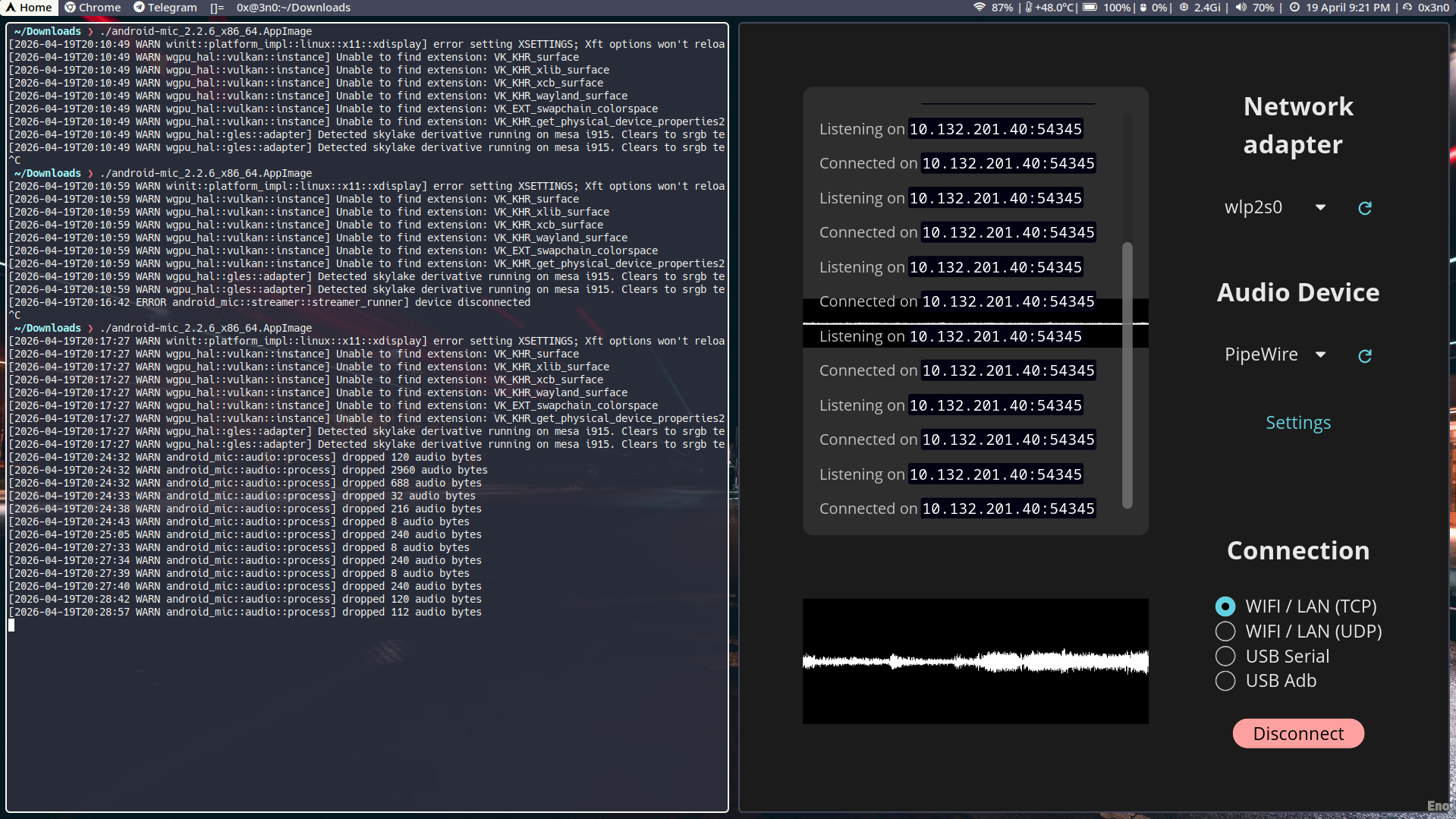
- Network adapter: pick your WiFi interface (like
wlp2s0with your local IP, e.g., 10.132.x.x) - Audio Device:
Default ALSA Output (currently PipeWire Media Server) - Connection:
WIFI / LAN (TCP)(UDP is faster but risky, no cap) - Click Connect. It'll show an IP and port like
10.132.201.40:12345. Remember that.
- Open AndroidMic app on your Samsung A51.
- Type in that IP and port from your PC.
- Tap Connect.
- If it says "Connected" on PC, you're winning.
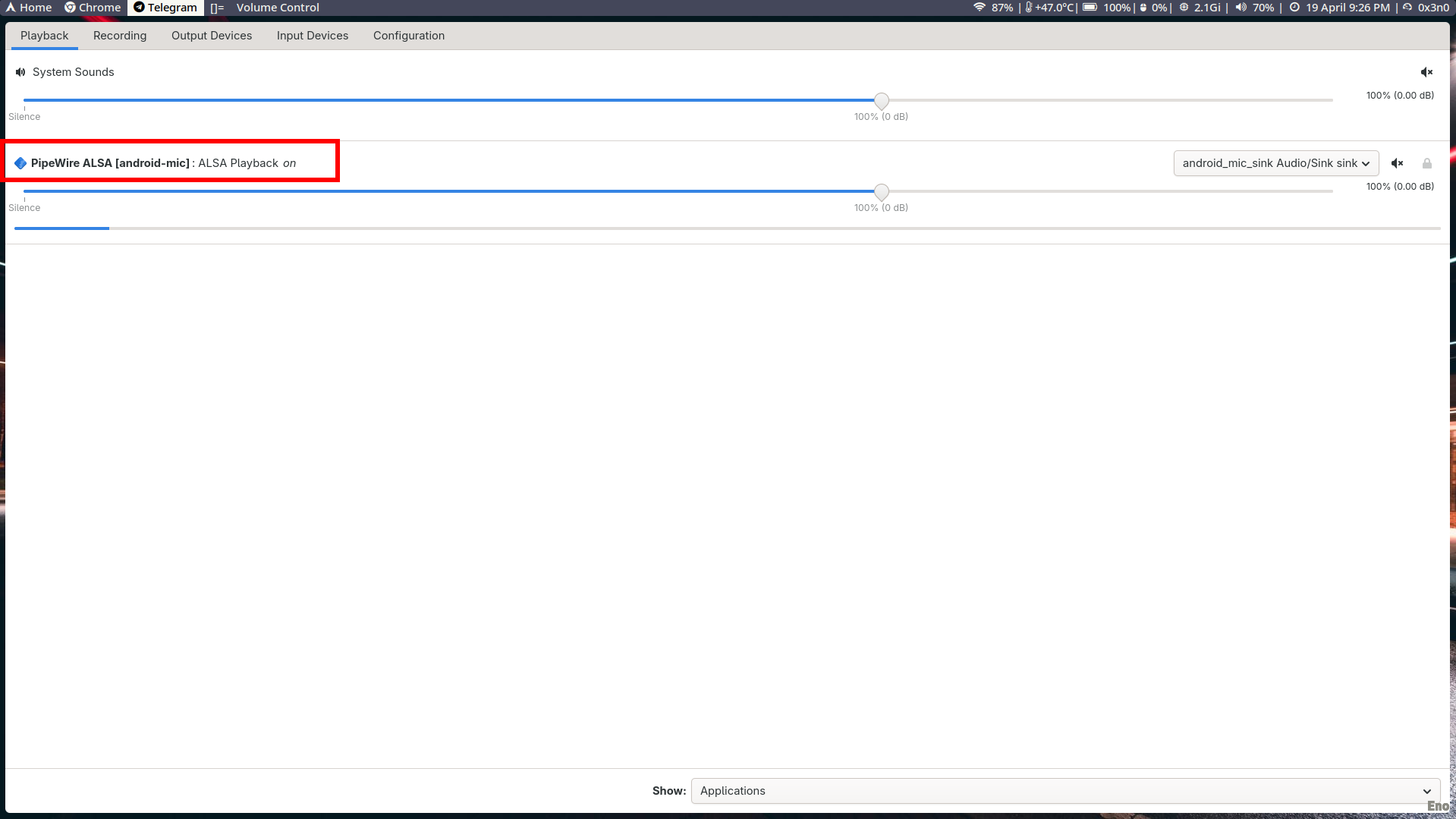
Open pavucontrol:
pavucontrolNow do this:
- Playback tab → find "PipeWire ALSA [android-mic]: ALSA Playback on" → click the dropdown button (speaker icon) → select
android_mic_sink(NOT your TWS or speakers). - Recording tab → when you're on a call in Discord/Telegram, make sure the input device is
android_mic_source. You can also set it as default:pactl set-default-source android_mic_source
- Output Devices tab → make sure your TWS is selected as the output for system sounds (so you can hear your friends while using your phone as mic).
Wait, my TWS mic?
If you wanna use your TWS's built-in mic instead of the phone, just change the input device in your app to your TWS's "Headset" profile. But this guide is for using the PHONE as mic, so we ignore that.
- Discord: User Settings → Voice & Video → Input Device =
android_mic_source. Output = your TWS. - Telegram: Settings → Advanced → Voice Calls → Microphone =
android_mic_source. - Google Meet: Click the three dots → Settings → Microphone =
android_mic_source.
Sheesh. Now you're the main character with a wireless mic setup that cost you $0 extra.
Add this to your ~/.bashrc or ~/.profile:
if ! pactl list sinks short | grep -q android_mic_sink; then
    pactl load-module module-null-sink sink_name=android_mic_sink
    pactl load-module module-remap-source master=android_mic_sink.monitor source_name=android_mic_source
fi
Or create a systemd user service if you're extra. But the bashrc method is lowkey enough.
| Problem | Fix (No panic) |
|---|---|
android_mic_source not showing in apps |
Did you run the second pactl command? Check pavucontrol Input Devices tab. |
| Audio from phone but can't hear in call | Go to Recording tab in pavucontrol → set app's input to android_mic_source. |
| AndroidMic won't connect | Check firewall? Same WiFi? Try restarting app on phone and PC. Or use USB ADB mode instead. |
| TWS disconnects after a while | Add btusb.enable_autosuspend=n to kernel params as shown above. |
| Everything works but mic volume too low | In pavucontrol → Input Devices → increase volume for android_mic_source. |
You just turned your old Samsung A51 into a pro-level wireless microphone on Arch Linux, while still vibing with your TWS earbuds. That's what we call a "budget slay." No need to buy a Blue Yeti or a standalone mic. Your phone + Arch + AndroidMic = infinite rizz.
Now go flex on your Discord homies. And remember: virtual devices first, then connect AndroidMic, then route audio in pavucontrol. That's the cheat code.
Catch you on the flip side, king/queen/nonbinary royalty.

First, I gotta say this is unironically ('cause like, y'know, I'm an elder millennial and I have to announce whether I'm doing or liking something ironically or not... Also we were doing it before it was cool and mainstream.. ᐠ(❤⩊❤)ᐟ ) the best github gist I've ever encountered. 7/7 Def my favourite.
And second, again because elder millennial (40 in 3 days, FuckI'mOld), and I mean this affectionately:
Listen here you little shit...
(╯❤⩊❤)╯ ︵ ƃuᴉƃ∀