
Last active
July 5, 2024 02:29
-
-
Save Zhaoyilunnn/37fe80b2132e7176fc8d77c72b3368a0 to your computer and use it in GitHub Desktop.
Revisions
-
Zhaoyilunnn revised this gist
Jul 5, 2024 . 1 changed file with 13 additions and 7 deletions.There are no files selected for viewing
This file contains hidden or bidirectional Unicode text that may be interpreted or compiled differently than what appears below. To review, open the file in an editor that reveals hidden Unicode characters. Learn more about bidirectional Unicode charactersOriginal file line number Diff line number Diff line change @@ -519,6 +519,12 @@ Sparse topology (i.e., the way to prune gates?) changes each time the weights ar - Solution: backpropogation on simulator, but using measurement from real machine ### Clapton *Key Insight* - VQA can be transform to another equivalent VQA problem with *different* state search space, without affecting the final solution (energy). ## LLM @@ -664,11 +670,11 @@ Encoding $2^n$-dimentional vector using $n$ qubits. [Nelder–Mead method](https://en.wikipedia.org/wiki/Nelder%E2%80%93Mead_method) <!--stackedit_data: eyJoaXN0b3J5IjpbNDg1MDYzNjIsMjY0MzE0NDAsLTIxMzcwND g4MzEsMjAwODc4MzA4MCw1NTc5NTA5MzgsLTEyODA2NjQwNTcs LTIwMTI5NTgzNDUsOTE2MzI4MzksLTEwMTQxOTA4ODEsMzI1OT Y2NzM0LC00NzA0NzU0MSwtMTQ3MzI2MDQ5OCwtOTI4MzEzMDYz LDE5MjMzOTcyOTUsLTIwMDkwNDQ1NzIsMTU5NDkxOTkxMywtMT A3NDkyMzYzOSwxNzgzMDk1OTA5LDE2MTA4MTMyMjMsLTEyMDA1 NDgyMTFdfQ== --> -
Jul 5, 2024 . 1 changed file with 8 additions and 7 deletions.There are no files selected for viewing
This file contains hidden or bidirectional Unicode text that may be interpreted or compiled differently than what appears below. To review, open the file in an editor that reveals hidden Unicode characters. Learn more about bidirectional Unicode charactersOriginal file line number Diff line number Diff line change @@ -373,6 +373,7 @@ The measurement results represent the solutions. - FrozenQubits: Boosting Fidelity of QAOA by Skipping Hotspot Nodes, ASPLOS-2023 - RobustState: Boosting Fidelity of Quantum State Preparation via Noise-Aware Variational Training, Hanrui Wang, MIT. - Combining Parameterized Pulses and Contextual Subspace for More Practical VQE. DAC. 2024 - Clapton: Clifford-Assisted Problem Transformation for Error Mitigation in Variational Quantum Algorithms. Fred Chong. 2024 ### AI @@ -663,11 +664,11 @@ Encoding $2^n$-dimentional vector using $n$ qubits. [Nelder–Mead method](https://en.wikipedia.org/wiki/Nelder%E2%80%93Mead_method) <!--stackedit_data: eyJoaXN0b3J5IjpbLTc1Njg4MjA1MiwyNjQzMTQ0MCwtMjEzNz A0ODgzMSwyMDA4NzgzMDgwLDU1Nzk1MDkzOCwtMTI4MDY2NDA1 NywtMjAxMjk1ODM0NSw5MTYzMjgzOSwtMTAxNDE5MDg4MSwzMj U5NjY3MzQsLTQ3MDQ3NTQxLC0xNDczMjYwNDk4LC05MjgzMTMw NjMsMTkyMzM5NzI5NSwtMjAwOTA0NDU3MiwxNTk0OTE5OTEzLC 0xMDc0OTIzNjM5LDE3ODMwOTU5MDksMTYxMDgxMzIyMywtMTIw MDU0ODIxMV19 --> -
Jun 26, 2024 . 1 changed file with 8 additions and 6 deletions.There are no files selected for viewing
This file contains hidden or bidirectional Unicode text that may be interpreted or compiled differently than what appears below. To review, open the file in an editor that reveals hidden Unicode characters. Learn more about bidirectional Unicode charactersOriginal file line number Diff line number Diff line change @@ -372,6 +372,7 @@ The measurement results represent the solutions. - **A co-design framework of neural networks and quantum circuits towards quantum advantage, NC-2021** - FrozenQubits: Boosting Fidelity of QAOA by Skipping Hotspot Nodes, ASPLOS-2023 - RobustState: Boosting Fidelity of Quantum State Preparation via Noise-Aware Variational Training, Hanrui Wang, MIT. - Combining Parameterized Pulses and Contextual Subspace for More Practical VQE. DAC. 2024 ### AI @@ -662,10 +663,11 @@ Encoding $2^n$-dimentional vector using $n$ qubits. [Nelder–Mead method](https://en.wikipedia.org/wiki/Nelder%E2%80%93Mead_method) <!--stackedit_data: eyJoaXN0b3J5IjpbMjY0MzE0NDAsLTIxMzcwNDg4MzEsMjAwOD c4MzA4MCw1NTc5NTA5MzgsLTEyODA2NjQwNTcsLTIwMTI5NTgz NDUsOTE2MzI4MzksLTEwMTQxOTA4ODEsMzI1OTY2NzM0LC00Nz A0NzU0MSwtMTQ3MzI2MDQ5OCwtOTI4MzEzMDYzLDE5MjMzOTcy OTUsLTIwMDkwNDQ1NzIsMTU5NDkxOTkxMywtMTA3NDkyMzYzOS wxNzgzMDk1OTA5LDE2MTA4MTMyMjMsLTEyMDA1NDgyMTFdfQ== --> -
Feb 10, 2024 . 1 changed file with 9 additions and 6 deletions.There are no files selected for viewing
This file contains hidden or bidirectional Unicode text that may be interpreted or compiled differently than what appears below. To review, open the file in an editor that reveals hidden Unicode characters. Learn more about bidirectional Unicode charactersOriginal file line number Diff line number Diff line change @@ -31,6 +31,9 @@ def shift_and_run(model, inputs, use_qiskit=False): return model(inputs, use_qiskit), grad_list ``` ### Expectation - k-commutativity and measurement reduction for expectation values, arXiv, 2023 ## Machine Learning @@ -659,10 +662,10 @@ Encoding $2^n$-dimentional vector using $n$ qubits. [Nelder–Mead method](https://en.wikipedia.org/wiki/Nelder%E2%80%93Mead_method) <!--stackedit_data: eyJoaXN0b3J5IjpbLTIxMzcwNDg4MzEsMjAwODc4MzA4MCw1NT c5NTA5MzgsLTEyODA2NjQwNTcsLTIwMTI5NTgzNDUsOTE2MzI4 MzksLTEwMTQxOTA4ODEsMzI1OTY2NzM0LC00NzA0NzU0MSwtMT Q3MzI2MDQ5OCwtOTI4MzEzMDYzLDE5MjMzOTcyOTUsLTIwMDkw NDQ1NzIsMTU5NDkxOTkxMywtMTA3NDkyMzYzOSwxNzgzMDk1OT A5LDE2MTA4MTMyMjMsLTEyMDA1NDgyMTFdfQ== --> -
Jan 23, 2024 . 1 changed file with 15 additions and 6 deletions.There are no files selected for viewing
This file contains hidden or bidirectional Unicode text that may be interpreted or compiled differently than what appears below. To review, open the file in an editor that reveals hidden Unicode characters. Learn more about bidirectional Unicode charactersOriginal file line number Diff line number Diff line change @@ -492,6 +492,15 @@ Mapping specially designed neural network to quantum circuit. *Key Insights* - The quantum divergence will concentrate to maximal mixed state with the depth increase. *Experiments* - On MNIST, downsample to $4\times 4$, encode using below angle encoding method, into $n$-qubit quantum states with encoding depth $D$, with $n\in \{2,3,4,6,8\}$ and $D\in \{8,6,4,3,2\}$ accordingly. - Verify that with depth increase, accuracy decrease....   ### QuantumSEA *Key Insight* Sparse topology (i.e., the way to prune gates?) changes each time the weights are updated. @@ -650,10 +659,10 @@ Encoding $2^n$-dimentional vector using $n$ qubits. [Nelder–Mead method](https://en.wikipedia.org/wiki/Nelder%E2%80%93Mead_method) <!--stackedit_data: eyJoaXN0b3J5IjpbMjAwODc4MzA4MCw1NTc5NTA5MzgsLTEyOD A2NjQwNTcsLTIwMTI5NTgzNDUsOTE2MzI4MzksLTEwMTQxOTA4 ODEsMzI1OTY2NzM0LC00NzA0NzU0MSwtMTQ3MzI2MDQ5OCwtOT I4MzEzMDYzLDE5MjMzOTcyOTUsLTIwMDkwNDQ1NzIsMTU5NDkx OTkxMywtMTA3NDkyMzYzOSwxNzgzMDk1OTA5LDE2MTA4MTMyMj MsLTEyMDA1NDgyMTFdfQ== --> -
Jan 23, 2024 . 1 changed file with 15 additions and 6 deletions.There are no files selected for viewing
This file contains hidden or bidirectional Unicode text that may be interpreted or compiled differently than what appears below. To review, open the file in an editor that reveals hidden Unicode characters. Learn more about bidirectional Unicode charactersOriginal file line number Diff line number Diff line change @@ -485,6 +485,13 @@ A co-design framework of neural networks and quantum circuits towards quantum ad Mapping specially designed neural network to quantum circuit. ### Concentration of Data Encoding - NIPS-2022 *Key Insights* - The quantum divergence will concentrate to maximal mixed state with the depth increase. ### QuantumSEA *Key Insight* Sparse topology (i.e., the way to prune gates?) changes each time the weights are updated. @@ -497,6 +504,8 @@ Sparse topology (i.e., the way to prune gates?) changes each time the weights ar - Simulator backpropogation ⇒ low robustness - Solution: backpropogation on simulator, but using measurement from real machine ## LLM References @@ -641,10 +650,10 @@ Encoding $2^n$-dimentional vector using $n$ qubits. [Nelder–Mead method](https://en.wikipedia.org/wiki/Nelder%E2%80%93Mead_method) <!--stackedit_data: eyJoaXN0b3J5IjpbLTE3MDY4ODcwOTksNTU3OTUwOTM4LC0xMj gwNjY0MDU3LC0yMDEyOTU4MzQ1LDkxNjMyODM5LC0xMDE0MTkw ODgxLDMyNTk2NjczNCwtNDcwNDc1NDEsLTE0NzMyNjA0OTgsLT kyODMxMzA2MywxOTIzMzk3Mjk1LC0yMDA5MDQ0NTcyLDE1OTQ5 MTk5MTMsLTEwNzQ5MjM2MzksMTc4MzA5NTkwOSwxNjEwODEzMj IzLC0xMjAwNTQ4MjExXX0= --> -
Jan 18, 2024 . 1 changed file with 10 additions and 7 deletions.There are no files selected for viewing
This file contains hidden or bidirectional Unicode text that may be interpreted or compiled differently than what appears below. To review, open the file in an editor that reveals hidden Unicode characters. Learn more about bidirectional Unicode charactersOriginal file line number Diff line number Diff line change @@ -492,7 +492,10 @@ Sparse topology (i.e., the way to prune gates?) changes each time the weights ar ### RobustState *Motivation* - Parameter Shift ⇒ low training efficiency - Simulator backpropogation ⇒ low robustness - Solution: backpropogation on simulator, but using measurement from real machine ## LLM @@ -638,10 +641,10 @@ Encoding $2^n$-dimentional vector using $n$ qubits. [Nelder–Mead method](https://en.wikipedia.org/wiki/Nelder%E2%80%93Mead_method) <!--stackedit_data: eyJoaXN0b3J5IjpbNTU3OTUwOTM4LC0xMjgwNjY0MDU3LC0yMD EyOTU4MzQ1LDkxNjMyODM5LC0xMDE0MTkwODgxLDMyNTk2Njcz NCwtNDcwNDc1NDEsLTE0NzMyNjA0OTgsLTkyODMxMzA2MywxOT IzMzk3Mjk1LC0yMDA5MDQ0NTcyLDE1OTQ5MTk5MTMsLTEwNzQ5 MjM2MzksMTc4MzA5NTkwOSwxNjEwODEzMjIzLC0xMjAwNTQ4Mj ExXX0= --> -
Jan 18, 2024 . 1 changed file with 12 additions and 5 deletions.There are no files selected for viewing
This file contains hidden or bidirectional Unicode text that may be interpreted or compiled differently than what appears below. To review, open the file in an editor that reveals hidden Unicode characters. Learn more about bidirectional Unicode charactersOriginal file line number Diff line number Diff line change @@ -368,6 +368,7 @@ The measurement results represent the solutions. - **A Hybrid Deep Neural Network Architecture based on Quantum State Fidelity. MLSYS-2022** - **A co-design framework of neural networks and quantum circuits towards quantum advantage, NC-2021** - FrozenQubits: Boosting Fidelity of QAOA by Skipping Hotspot Nodes, ASPLOS-2023 - RobustState: Boosting Fidelity of Quantum State Preparation via Noise-Aware Variational Training, Hanrui Wang, MIT. ### AI @@ -488,6 +489,11 @@ Mapping specially designed neural network to quantum circuit. *Key Insight* Sparse topology (i.e., the way to prune gates?) changes each time the weights are updated. ### RobustState - ## LLM References @@ -632,9 +638,10 @@ Encoding $2^n$-dimentional vector using $n$ qubits. [Nelder–Mead method](https://en.wikipedia.org/wiki/Nelder%E2%80%93Mead_method) <!--stackedit_data: eyJoaXN0b3J5IjpbMTc2NjA5NDYxOCwtMTI4MDY2NDA1NywtMj AxMjk1ODM0NSw5MTYzMjgzOSwtMTAxNDE5MDg4MSwzMjU5NjY3 MzQsLTQ3MDQ3NTQxLC0xNDczMjYwNDk4LC05MjgzMTMwNjMsMT kyMzM5NzI5NSwtMjAwOTA0NDU3MiwxNTk0OTE5OTEzLC0xMDc0 OTIzNjM5LDE3ODMwOTU5MDksMTYxMDgxMzIyMywtMTIwMDU0OD IxMV19 --> -
Dec 25, 2023 . 1 changed file with 9 additions and 5 deletions.There are no files selected for viewing
This file contains hidden or bidirectional Unicode text that may be interpreted or compiled differently than what appears below. To review, open the file in an editor that reveals hidden Unicode characters. Learn more about bidirectional Unicode charactersOriginal file line number Diff line number Diff line change @@ -438,6 +438,10 @@ The measurement results represent the solutions. - Concentration of Data Encoding in Parameterized Quantum Circuits. NIPS-2022 - Quantum Algorithms for Sampling Log-Concave Distributions and Estimating Normalizing Constants. NIPS-2022 - Power and limitations of single-qubit native quantum neural networks. NIPS-2022 - A Quantum-inspired Classical Algorithm for Separable Non-negative Matrix Factorization. IJCAI-2019 - Quantum-Inspired Interactive Networks for Conversational Sentiment Analysis. IJCAI-2019 - A Quantum-inspired Entropic Kernel for Multiple Financial Time Series Analysis. IJCAI-2020 - Solving Quantum-Inspired Perfect Matching Problems via Tutte-Theorem-Based Hybrid Boolean Constraints. IJCAI-2023 ### Misc - Exponential Quantum Communication Advantage in Distributed Learning, Google, 2023 @@ -628,9 +632,9 @@ Encoding $2^n$-dimentional vector using $n$ qubits. [Nelder–Mead method](https://en.wikipedia.org/wiki/Nelder%E2%80%93Mead_method) <!--stackedit_data: eyJoaXN0b3J5IjpbLTEyODA2NjQwNTcsLTIwMTI5NTgzNDUsOT E2MzI4MzksLTEwMTQxOTA4ODEsMzI1OTY2NzM0LC00NzA0NzU0 MSwtMTQ3MzI2MDQ5OCwtOTI4MzEzMDYzLDE5MjMzOTcyOTUsLT IwMDkwNDQ1NzIsMTU5NDkxOTkxMywtMTA3NDkyMzYzOSwxNzgz MDk1OTA5LDE2MTA4MTMyMjMsLTEyMDA1NDgyMTFdfQ== --> -
Dec 25, 2023 . 1 changed file with 6 additions and 6 deletions.There are no files selected for viewing
This file contains hidden or bidirectional Unicode text that may be interpreted or compiled differently than what appears below. To review, open the file in an editor that reveals hidden Unicode characters. Learn more about bidirectional Unicode charactersOriginal file line number Diff line number Diff line change @@ -410,7 +410,7 @@ The measurement results represent the solutions. - **Tensor Network Based Efficient Quantum Data Loading of Images, IonQ-2023** - Symmetric Pruning in Quantum Neural Networks, ICLR-2023 - Quanvolutional Neural Networks: Powering Image Recognition with Quantum Circuits, - Quantum Speedups for Zero-Sum Games via Improved Dynamic Gibbs Sampling. ICML-2023 - Q-Flow: Generative Modeling for Differential Equations of Open Quantum Dynamics with Normalizing Flows. ICML-2023 - Learning Distributions over Quantum Measurement Outcomes. ICML-2023 - Efficient Quantum Algorithms for Quantum Optimal Control. ICML-2023 @@ -628,9 +628,9 @@ Encoding $2^n$-dimentional vector using $n$ qubits. [Nelder–Mead method](https://en.wikipedia.org/wiki/Nelder%E2%80%93Mead_method) <!--stackedit_data: eyJoaXN0b3J5IjpbLTQyNDEwMTk1MCwtMjAxMjk1ODM0NSw5MT YzMjgzOSwtMTAxNDE5MDg4MSwzMjU5NjY3MzQsLTQ3MDQ3NTQx LC0xNDczMjYwNDk4LC05MjgzMTMwNjMsMTkyMzM5NzI5NSwtMj AwOTA0NDU3MiwxNTk0OTE5OTEzLC0xMDc0OTIzNjM5LDE3ODMw OTU5MDksMTYxMDgxMzIyMywtMTIwMDU0ODIxMV19 --> -
Dec 25, 2023 . 1 changed file with 7 additions and 7 deletions.There are no files selected for viewing
This file contains hidden or bidirectional Unicode text that may be interpreted or compiled differently than what appears below. To review, open the file in an editor that reveals hidden Unicode characters. Learn more about bidirectional Unicode charactersOriginal file line number Diff line number Diff line change @@ -425,11 +425,11 @@ The measurement results represent the solutions. - Analyzing Convergence in Quantum Neural Networks: Deviations from Neural Tangent Kernels. ICML-2023 - Efficient and Equivariant Graph Networks for Predicting Quantum Hamiltonian. ICML-2023 - Quantum Lower Bounds for Finding Stationary Points of Nonconvex Functions. ICML-2023 - Symmetric Pruning in Quantum Neural Networks. ICLR-2023 - QuAnt: Quantum Annealing with Learnt Couplings. ICLR-2023 - A Self-Attention Ansatz for Ab-initio Quantum Chemistry. ICLR-2023 - Classically Approximating Variational Quantum Machine Learning with Random Fourier Features. ICLR-2023 - Quantum Speedups of Optimizing Approximately Convex Functions with Applications to Logarithmic Regret Stochastic Convex Bandits. NIPS-2022 - Matrix Multiplicative Weights Updates in Quantum Zero-Sum Games: Conservation Laws & Recurrence. NIPS-2022 - Differentiable Analog Quantum Computing for Optimization and Control. NIPS-2022 - GraphQNTK: Quantum Neural Tangent Kernel for Graph Data. NIPS-2022 @@ -628,9 +628,9 @@ Encoding $2^n$-dimentional vector using $n$ qubits. [Nelder–Mead method](https://en.wikipedia.org/wiki/Nelder%E2%80%93Mead_method) <!--stackedit_data: eyJoaXN0b3J5IjpbNzY1NTg2NzY3LC0yMDEyOTU4MzQ1LDkxNj MyODM5LC0xMDE0MTkwODgxLDMyNTk2NjczNCwtNDcwNDc1NDEs LTE0NzMyNjA0OTgsLTkyODMxMzA2MywxOTIzMzk3Mjk1LC0yMD A5MDQ0NTcyLDE1OTQ5MTk5MTMsLTEwNzQ5MjM2MzksMTc4MzA5 NTkwOSwxNjEwODEzMjIzLC0xMjAwNTQ4MjExXX0= --> -
Dec 25, 2023 . 1 changed file with 33 additions and 5 deletions.There are no files selected for viewing
This file contains hidden or bidirectional Unicode text that may be interpreted or compiled differently than what appears below. To review, open the file in an editor that reveals hidden Unicode characters. Learn more about bidirectional Unicode charactersOriginal file line number Diff line number Diff line change @@ -410,6 +410,34 @@ The measurement results represent the solutions. - **Tensor Network Based Efficient Quantum Data Loading of Images, IonQ-2023** - Symmetric Pruning in Quantum Neural Networks, ICLR-2023 - Quanvolutional Neural Networks: Powering Image Recognition with Quantum Circuits, - - Quantum Speedups for Zero-Sum Games via Improved Dynamic Gibbs Sampling. ICML-2023 - Q-Flow: Generative Modeling for Differential Equations of Open Quantum Dynamics with Normalizing Flows. ICML-2023 - Learning Distributions over Quantum Measurement Outcomes. ICML-2023 - Efficient Quantum Algorithms for Quantum Optimal Control. ICML-2023 - QAS-Bench: Rethinking Quantum Architecture Search and A Benchmark. ICML-2023 - Quantum Policy Gradient Algorithm with Optimized Action Decoding. ICML-2023 - A Hybrid Quantum-Classical Approach based on the Hadamard Transform for the Convolutional Layer. ICML-2023 - QuantumDARTS: Differentiable Quantum Architecture Search for Variational Quantum Algorithms. ICML-2023 - Near-Optimal Quantum Coreset Construction Algorithms for Clustering. ICML-2023 - Quantum Ridgelet Transform: Winning Lottery Ticket of Neural Networks with Quantum Computation. ICML-2023 - Quantum 3D Graph Learning with Applications to Molecule Embedding. ICML-2023 - Towards Quantum Machine Learning for Constrained Combinatorial Optimization: a Quantum QAP Solver. ICML-2023 - Analyzing Convergence in Quantum Neural Networks: Deviations from Neural Tangent Kernels. ICML-2023 - Efficient and Equivariant Graph Networks for Predicting Quantum Hamiltonian. ICML-2023 - Quantum Lower Bounds for Finding Stationary Points of Nonconvex Functions. ICML-2023 - - Symmetric Pruning in Quantum Neural Networks. ICLR-2023 - QuAnt: Quantum Annealing with Learnt Couplings. ICLR-2023 - A Self-Attention Ansatz for Ab-initio Quantum Chemistry. ICLR-2023 - Classically Approximating Variational Quantum Machine Learning with Random Fourier Features. ICLR-2023 - - Quantum Speedups of Optimizing Approximately Convex Functions with Applications to Logarithmic Regret Stochastic Convex Bandits. NIPS-2022 - Matrix Multiplicative Weights Updates in Quantum Zero-Sum Games: Conservation Laws & Recurrence. NIPS-2022 - Differentiable Analog Quantum Computing for Optimization and Control. NIPS-2022 - GraphQNTK: Quantum Neural Tangent Kernel for Graph Data. NIPS-2022 - Systematic improvement of neural network quantum states using Lanczos. NIPS-2022 - Escaping from the Barren Plateau via Gaussian Initializations in Deep Variational Quantum Circuits. NIPS-2022 - Concentration of Data Encoding in Parameterized Quantum Circuits. NIPS-2022 - Quantum Algorithms for Sampling Log-Concave Distributions and Estimating Normalizing Constants. NIPS-2022 - Power and limitations of single-qubit native quantum neural networks. NIPS-2022 ### Misc - Exponential Quantum Communication Advantage in Distributed Learning, Google, 2023 @@ -600,9 +628,9 @@ Encoding $2^n$-dimentional vector using $n$ qubits. [Nelder–Mead method](https://en.wikipedia.org/wiki/Nelder%E2%80%93Mead_method) <!--stackedit_data: eyJoaXN0b3J5IjpbLTE0NzcwODUwNzksLTIwMTI5NTgzNDUsOT E2MzI4MzksLTEwMTQxOTA4ODEsMzI1OTY2NzM0LC00NzA0NzU0 MSwtMTQ3MzI2MDQ5OCwtOTI4MzEzMDYzLDE5MjMzOTcyOTUsLT IwMDkwNDQ1NzIsMTU5NDkxOTkxMywtMTA3NDkyMzYzOSwxNzgz MDk1OTA5LDE2MTA4MTMyMjMsLTEyMDA1NDgyMTFdfQ== --> -
Dec 12, 2023 . 1 changed file with 2 additions and 2 deletions.There are no files selected for viewing
This file contains hidden or bidirectional Unicode text that may be interpreted or compiled differently than what appears below. To review, open the file in an editor that reveals hidden Unicode characters. Learn more about bidirectional Unicode charactersOriginal file line number Diff line number Diff line change @@ -580,7 +580,7 @@ Each classical attention layer requires $2d^2$ free parameters. ### Related Work - Quantum convolutional neural networks, Nature Physics, 2019 - Quanvolutional Neural Networks: Powering Image Recognition with Quantum Circuits, Quantum Machine Intelligence (Authors have run away...) ## Dataset @@ -600,7 +600,7 @@ Encoding $2^n$-dimentional vector using $n$ qubits. [Nelder–Mead method](https://en.wikipedia.org/wiki/Nelder%E2%80%93Mead_method) <!--stackedit_data: eyJoaXN0b3J5IjpbLTIwMTI5NTgzNDUsOTE2MzI4MzksLTEwMT QxOTA4ODEsMzI1OTY2NzM0LC00NzA0NzU0MSwtMTQ3MzI2MDQ5 OCwtOTI4MzEzMDYzLDE5MjMzOTcyOTUsLTIwMDkwNDQ1NzIsMT U5NDkxOTkxMywtMTA3NDkyMzYzOSwxNzgzMDk1OTA5LDE2MTA4 -
Dec 12, 2023 . 1 changed file with 12 additions and 5 deletions.There are no files selected for viewing
This file contains hidden or bidirectional Unicode text that may be interpreted or compiled differently than what appears below. To review, open the file in an editor that reveals hidden Unicode characters. Learn more about bidirectional Unicode charactersOriginal file line number Diff line number Diff line change @@ -575,6 +575,13 @@ Each classical attention layer requires $2d^2$ free parameters. 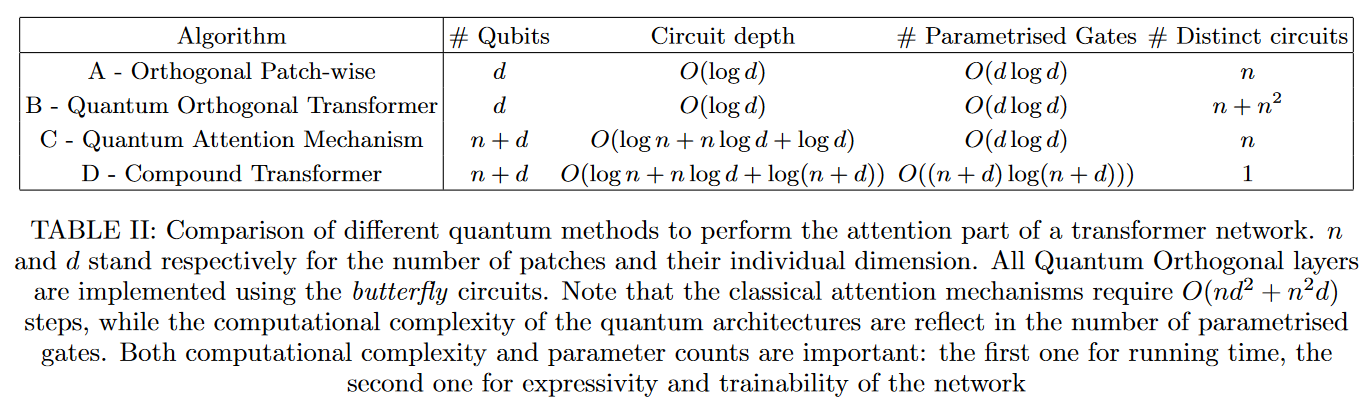 ## Quantum Convolutional Neural Networks ### Related Work - Quantum convolutional neural networks, Nature Physics, 2019 - Quanvolutional Neural Networks: Powering Image Recognition with Quantum Circuits, Quantum Machine Intelligence ## Dataset QM7-X: https://arxiv.org/pdf/2006.15139.pdf @@ -593,9 +600,9 @@ Encoding $2^n$-dimentional vector using $n$ qubits. [Nelder–Mead method](https://en.wikipedia.org/wiki/Nelder%E2%80%93Mead_method) <!--stackedit_data: eyJoaXN0b3J5IjpbLTE1NDQxMTQzMzcsOTE2MzI4MzksLTEwMT QxOTA4ODEsMzI1OTY2NzM0LC00NzA0NzU0MSwtMTQ3MzI2MDQ5 OCwtOTI4MzEzMDYzLDE5MjMzOTcyOTUsLTIwMDkwNDQ1NzIsMT U5NDkxOTkxMywtMTA3NDkyMzYzOSwxNzgzMDk1OTA5LDE2MTA4 MTMyMjMsLTEyMDA1NDgyMTFdfQ== --> -
Dec 1, 2023 . 1 changed file with 6 additions and 5 deletions.There are no files selected for viewing
This file contains hidden or bidirectional Unicode text that may be interpreted or compiled differently than what appears below. To review, open the file in an editor that reveals hidden Unicode characters. Learn more about bidirectional Unicode charactersOriginal file line number Diff line number Diff line change @@ -416,6 +416,7 @@ The measurement results represent the solutions. - Engineered dissipation to mitigate barren plateaus, IBM, 2023 - Quanvolutional Neural Networks: Powering Image Recognition with Quantum Circuits, Quantum Machine Intelligence, 2020 - Navigating the Dynamic Noise Landscape of Variational Quantum Algorithms with QISMET, ASPLOS, 2023 - RobustState: Boosting Fidelity of Quantum State Preparation via Noise-Aware Variational Training, Hanrui Wang, 2023 ## Basis @@ -592,9 +593,9 @@ Encoding $2^n$-dimentional vector using $n$ qubits. [Nelder–Mead method](https://en.wikipedia.org/wiki/Nelder%E2%80%93Mead_method) <!--stackedit_data: eyJoaXN0b3J5IjpbOTE2MzI4MzksLTEwMTQxOTA4ODEsMzI1OT Y2NzM0LC00NzA0NzU0MSwtMTQ3MzI2MDQ5OCwtOTI4MzEzMDYz LDE5MjMzOTcyOTUsLTIwMDkwNDQ1NzIsMTU5NDkxOTkxMywtMT A3NDkyMzYzOSwxNzgzMDk1OTA5LDE2MTA4MTMyMjMsLTEyMDA1 NDgyMTFdfQ== --> -
Nov 20, 2023 . 1 changed file with 6 additions and 4 deletions.There are no files selected for viewing
This file contains hidden or bidirectional Unicode text that may be interpreted or compiled differently than what appears below. To review, open the file in an editor that reveals hidden Unicode characters. Learn more about bidirectional Unicode charactersOriginal file line number Diff line number Diff line change @@ -367,6 +367,7 @@ The measurement results represent the solutions. - **On-chip QNN: Towards Efficient On-Chip Training of Quantum Neural Networks, DAC-2022** - **A Hybrid Deep Neural Network Architecture based on Quantum State Fidelity. MLSYS-2022** - **A co-design framework of neural networks and quantum circuits towards quantum advantage, NC-2021** - FrozenQubits: Boosting Fidelity of QAOA by Skipping Hotspot Nodes, ASPLOS-2023 ### AI @@ -591,8 +592,9 @@ Encoding $2^n$-dimentional vector using $n$ qubits. [Nelder–Mead method](https://en.wikipedia.org/wiki/Nelder%E2%80%93Mead_method) <!--stackedit_data: eyJoaXN0b3J5IjpbLTEwMTQxOTA4ODEsMzI1OTY2NzM0LC00Nz A0NzU0MSwtMTQ3MzI2MDQ5OCwtOTI4MzEzMDYzLDE5MjMzOTcy OTUsLTIwMDkwNDQ1NzIsMTU5NDkxOTkxMywtMTA3NDkyMzYzOS wxNzgzMDk1OTA5LDE2MTA4MTMyMjMsLTEyMDA1NDgyMTFdfQ== --> -
Nov 20, 2023 . 1 changed file with 6 additions and 5 deletions.There are no files selected for viewing
This file contains hidden or bidirectional Unicode text that may be interpreted or compiled differently than what appears below. To review, open the file in an editor that reveals hidden Unicode characters. Learn more about bidirectional Unicode charactersOriginal file line number Diff line number Diff line change @@ -348,7 +348,7 @@ The measurement results represent the solutions. - [x] When computing loss function, is it still an exponential size problem? # VQA ## Research Direction @@ -414,6 +414,7 @@ The measurement results represent the solutions. - Exponential Quantum Communication Advantage in Distributed Learning, Google, 2023 - Engineered dissipation to mitigate barren plateaus, IBM, 2023 - Quanvolutional Neural Networks: Powering Image Recognition with Quantum Circuits, Quantum Machine Intelligence, 2020 - Navigating the Dynamic Noise Landscape of Variational Quantum Algorithms with QISMET, ASPLOS, 2023 ## Basis @@ -590,8 +591,8 @@ Encoding $2^n$-dimentional vector using $n$ qubits. [Nelder–Mead method](https://en.wikipedia.org/wiki/Nelder%E2%80%93Mead_method) <!--stackedit_data: eyJoaXN0b3J5IjpbMzI1OTY2NzM0LC00NzA0NzU0MSwtMTQ3Mz I2MDQ5OCwtOTI4MzEzMDYzLDE5MjMzOTcyOTUsLTIwMDkwNDQ1 NzIsMTU5NDkxOTkxMywtMTA3NDkyMzYzOSwxNzgzMDk1OTA5LD E2MTA4MTMyMjMsLTEyMDA1NDgyMTFdfQ== --> -
Oct 31, 2023 . 1 changed file with 9 additions and 5 deletions.There are no files selected for viewing
This file contains hidden or bidirectional Unicode text that may be interpreted or compiled differently than what appears below. To review, open the file in an editor that reveals hidden Unicode characters. Learn more about bidirectional Unicode charactersOriginal file line number Diff line number Diff line change @@ -1,3 +1,7 @@ # News 1. [IBM 433Q](https://newsroom.ibm.com/2022-11-09-IBM-Unveils-400-Qubit-Plus-Quantum-Processor-and-Next-Generation-IBM-Quantum-System-Two) 2. [Atom Computing 1180 Q](https://www.newscientist.com/article/2399246-record-breaking-quantum-computer-has-more-than-1000-qubits/) # Applications Some evidence or verbal trick to illustrate the potential of quantum applications. @@ -61,7 +65,7 @@ Reference: https://qml.baidu.com/tutorials/quantum-simulation/hamiltonian-simula According to one of the fundamental axioms of quantum mechanics, the evolution of a system over time can be described by $$ i\hbar\frac{\partial}{\partial t}|\psi\rangle = H|\psi\rangle $$ $\hbar$ is the reduced Planck constant. This equation is the well-known Schrödinger equation. Thus, for a time independent Hamiltonian, the time evolution equation of the system can be written as $$ @@ -586,8 +590,8 @@ Encoding $2^n$-dimentional vector using $n$ qubits. [Nelder–Mead method](https://en.wikipedia.org/wiki/Nelder%E2%80%93Mead_method) <!--stackedit_data: eyJoaXN0b3J5IjpbLTQ3MDQ3NTQxLC0xNDczMjYwNDk4LC05Mj gzMTMwNjMsMTkyMzM5NzI5NSwtMjAwOTA0NDU3MiwxNTk0OTE5 OTEzLC0xMDc0OTIzNjM5LDE3ODMwOTU5MDksMTYxMDgxMzIyMy wtMTIwMDU0ODIxMV19 --> -
Oct 31, 2023 . 1 changed file with 5 additions and 5 deletions.There are no files selected for viewing
This file contains hidden or bidirectional Unicode text that may be interpreted or compiled differently than what appears below. To review, open the file in an editor that reveals hidden Unicode characters. Learn more about bidirectional Unicode charactersOriginal file line number Diff line number Diff line change @@ -409,7 +409,7 @@ The measurement results represent the solutions. ### Misc - Exponential Quantum Communication Advantage in Distributed Learning, Google, 2023 - Engineered dissipation to mitigate barren plateaus, IBM, 2023 - Quanvolutional Neural Networks: Powering Image Recognition with Quantum Circuits, Quantum Machine Intelligence, 2020 ## Basis @@ -586,8 +586,8 @@ Encoding $2^n$-dimentional vector using $n$ qubits. [Nelder–Mead method](https://en.wikipedia.org/wiki/Nelder%E2%80%93Mead_method) <!--stackedit_data: eyJoaXN0b3J5IjpbLTE0NzMyNjA0OTgsLTkyODMxMzA2MywxOT IzMzk3Mjk1LC0yMDA5MDQ0NTcyLDE1OTQ5MTk5MTMsLTEwNzQ5 MjM2MzksMTc4MzA5NTkwOSwxNjEwODEzMjIzLC0xMjAwNTQ4Mj ExXX0= --> -
Oct 31, 2023 . 1 changed file with 6 additions and 3 deletions.There are no files selected for viewing
This file contains hidden or bidirectional Unicode text that may be interpreted or compiled differently than what appears below. To review, open the file in an editor that reveals hidden Unicode characters. Learn more about bidirectional Unicode charactersOriginal file line number Diff line number Diff line change @@ -404,10 +404,12 @@ The measurement results represent the solutions. - Adiabatic Quantum Computing for Multi Object Tracking. CVPR-2022 - **Tensor Network Based Efficient Quantum Data Loading of Images, IonQ-2023** - Symmetric Pruning in Quantum Neural Networks, ICLR-2023 - Quanvolutional Neural Networks: Powering Image Recognition with Quantum Circuits, ### Misc - Exponential Quantum Communication Advantage in Distributed Learning, Google, 2023 - Engineered dissipation to mitigate barren plateaus, IBM, 2023 - Quanvolutional Neural Networks: Powering Image Recognition with Quantum Circuits ## Basis @@ -584,7 +586,8 @@ Encoding $2^n$-dimentional vector using $n$ qubits. [Nelder–Mead method](https://en.wikipedia.org/wiki/Nelder%E2%80%93Mead_method) <!--stackedit_data: eyJoaXN0b3J5IjpbMTEyMjExODc2NywtOTI4MzEzMDYzLDE5Mj MzOTcyOTUsLTIwMDkwNDQ1NzIsMTU5NDkxOTkxMywtMTA3NDky MzYzOSwxNzgzMDk1OTA5LDE2MTA4MTMyMjMsLTEyMDA1NDgyMT FdfQ== --> -
Oct 29, 2023 . 1 changed file with 29 additions and 25 deletions.There are no files selected for viewing
This file contains hidden or bidirectional Unicode text that may be interpreted or compiled differently than what appears below. To review, open the file in an editor that reveals hidden Unicode characters. Learn more about bidirectional Unicode charactersOriginal file line number Diff line number Diff line change @@ -407,28 +407,7 @@ The measurement results represent the solutions. ### Misc - Exponential Quantum Communication Advantage in Distributed Learning, Google, 2023 - Engineered dissipation to mitigate barren plateaus, IBM, 2023 ## Basis @@ -479,6 +458,31 @@ QNLP Resources 1. https://cqcl.github.io/lambeq/examples/circuit.html (lambeq, transform sentence -> diagrams -> circuit ) ## Misc ### Adiabatic Quantum Computing for Multi Object Tracking ***Background*** *QUBO* problem Quadratic Unconstrained Binary Optimization *MOT* https://zhuanlan.zhihu.com/p/97449724 Steps - Given a set of detections in each frame of a video, appearance features are extracted for each detection. - By using a multi-layer Perceptron, pairwise appearance similarities between detections at different timesteps are computed - Assign each detection to a track, such that the sum of the similarities of detections assigned to a single track is maximized. ***What is the problem?*** - Multi-Object Tracking is an NP-hard problem. ## Quantum Vision Transformer http://arxiv.org/abs/2209.08167 @@ -580,7 +584,7 @@ Encoding $2^n$-dimentional vector using $n$ qubits. [Nelder–Mead method](https://en.wikipedia.org/wiki/Nelder%E2%80%93Mead_method) <!--stackedit_data: eyJoaXN0b3J5IjpbLTkyODMxMzA2MywxOTIzMzk3Mjk1LC0yMD A5MDQ0NTcyLDE1OTQ5MTk5MTMsLTEwNzQ5MjM2MzksMTc4MzA5 NTkwOSwxNjEwODEzMjIzLC0xMjAwNTQ4MjExXX0= --> -
Oct 20, 2023 . 1 changed file with 4 additions and 3 deletions.There are no files selected for viewing
This file contains hidden or bidirectional Unicode text that may be interpreted or compiled differently than what appears below. To review, open the file in an editor that reveals hidden Unicode characters. Learn more about bidirectional Unicode charactersOriginal file line number Diff line number Diff line change @@ -403,6 +403,7 @@ The measurement results represent the solutions. - Semiconductor Defect Detection by Hybrid Classical-Quantum Deep Learning. CVPR-2022 - Adiabatic Quantum Computing for Multi Object Tracking. CVPR-2022 - **Tensor Network Based Efficient Quantum Data Loading of Images, IonQ-2023** - Symmetric Pruning in Quantum Neural Networks, ICLR-2023 ### Misc - Exponential Quantum Communication Advantage in Distributed Learning, Google, 2023 @@ -579,7 +580,7 @@ Encoding $2^n$-dimentional vector using $n$ qubits. [Nelder–Mead method](https://en.wikipedia.org/wiki/Nelder%E2%80%93Mead_method) <!--stackedit_data: eyJoaXN0b3J5IjpbMTkyMzM5NzI5NSwtMjAwOTA0NDU3MiwxNT k0OTE5OTEzLC0xMDc0OTIzNjM5LDE3ODMwOTU5MDksMTYxMDgx MzIyMywtMTIwMDU0ODIxMV19 --> -
Oct 17, 2023 . 1 changed file with 6 additions and 2 deletions.There are no files selected for viewing
This file contains hidden or bidirectional Unicode text that may be interpreted or compiled differently than what appears below. To review, open the file in an editor that reveals hidden Unicode characters. Learn more about bidirectional Unicode charactersOriginal file line number Diff line number Diff line change @@ -404,6 +404,9 @@ The measurement results represent the solutions. - Adiabatic Quantum Computing for Multi Object Tracking. CVPR-2022 - **Tensor Network Based Efficient Quantum Data Loading of Images, IonQ-2023** ### Misc - Exponential Quantum Communication Advantage in Distributed Learning, Google, 2023 #### Adiabatic Quantum Computing for Multi Object Tracking ***Background*** @@ -576,6 +579,7 @@ Encoding $2^n$-dimentional vector using $n$ qubits. [Nelder–Mead method](https://en.wikipedia.org/wiki/Nelder%E2%80%93Mead_method) <!--stackedit_data: eyJoaXN0b3J5IjpbLTIwMDkwNDQ1NzIsMTU5NDkxOTkxMywtMT A3NDkyMzYzOSwxNzgzMDk1OTA5LDE2MTA4MTMyMjMsLTEyMDA1 NDgyMTFdfQ== --> -
Oct 13, 2023 . 1 changed file with 3 additions and 2 deletions.There are no files selected for viewing
This file contains hidden or bidirectional Unicode text that may be interpreted or compiled differently than what appears below. To review, open the file in an editor that reveals hidden Unicode characters. Learn more about bidirectional Unicode charactersOriginal file line number Diff line number Diff line change @@ -402,6 +402,7 @@ The measurement results represent the solutions. - An Iterative Quantum Approach for Transformation Estimation from Point Sets. CVPR-2022 - Semiconductor Defect Detection by Hybrid Classical-Quantum Deep Learning. CVPR-2022 - Adiabatic Quantum Computing for Multi Object Tracking. CVPR-2022 - **Tensor Network Based Efficient Quantum Data Loading of Images, IonQ-2023** #### Adiabatic Quantum Computing for Multi Object Tracking @@ -575,6 +576,6 @@ Encoding $2^n$-dimentional vector using $n$ qubits. [Nelder–Mead method](https://en.wikipedia.org/wiki/Nelder%E2%80%93Mead_method) <!--stackedit_data: eyJoaXN0b3J5IjpbMTU5NDkxOTkxMywtMTA3NDkyMzYzOSwxNz gzMDk1OTA5LDE2MTA4MTMyMjMsLTEyMDA1NDgyMTFdfQ== --> -
Oct 13, 2023 . 1 changed file with 6 additions and 27 deletions.There are no files selected for viewing
This file contains hidden or bidirectional Unicode text that may be interpreted or compiled differently than what appears below. To review, open the file in an editor that reveals hidden Unicode characters. Learn more about bidirectional Unicode charactersOriginal file line number Diff line number Diff line change @@ -360,35 +360,28 @@ The measurement results represent the solutions. ### System - **On-chip QNN: Towards Efficient On-Chip Training of Quantum Neural Networks, DAC-2022** - **A Hybrid Deep Neural Network Architecture based on Quantum State Fidelity. MLSYS-2022** - **A co-design framework of neural networks and quantum circuits towards quantum advantage, NC-2021** ### AI - Estimating the Density of States of Boolean Satisfiability Problems on Classical and Quantum Computing Platforms. AAAI-2020 - Learning to Optimize Variational Quantum Circuits to Solve Combinatorial Problems. AAAI-2020 - Revisiting Online Quantum State Learning. AAAI-2020 - Quantum Probabilistic Models Using Feynman Diagram Rules for Better Understanding the Information Diffusion Dynamics in Online Social Networks. AAAI-2020 - Quantum Cognitively Motivated Decision Fusion for Video Sentiment Analysis. AAAI-2021 - Variational Shadow Quantum Learning for Classification. AAAI-2021 - Sublinear Classical and Quantum Algorithms for General Matrix Games. AAAI-2021 - Quantum Exploration Algorithms for Multi-Armed Bandits. AAAI-2021 - Quantum-inspired Neural Network for Conversational Emotion Recognition. AAAI-2021 - A Quantum-inspired Complex-valued Representation for Encoding Sentiment Information (Student Abstract). AAAI-2021 - Quantum Binary Classification (Student Abstract). AAAI-2021 - Toward Physically Realizable Quantum Neural Networks. AAAI-2022 - Effective Multi-Class Classification on Quantum Computers Using an Ensemble of Diverse Quantum Classifiers. AAAI-2022 - Quantum Algorithms for Deep Convolutional Neural Networks. ICLR-2020 - **Space-efficient Word Embeddings inspired by Quantum Entanglement. ICLR-2020** - Critical Points in Quantum Generative Models. ICLR-2022 - Sublinear quantum algorithms for training linear and kernel-based classifiers. ICML-2019 - Quantum Boosting. ICML-2020 - Quantum Expectation-Maximization for Gaussian mixture models. ICML-2020 @@ -398,27 +391,13 @@ The measurement results represent the solutions. - Exponentially Many Local Minima in Quantum Neural Networks. ICML-2021 - Quantum-Inspired Algorithms from Randomized Numerical Linear Algebra. ICML-2022 - Equivariant Quantum Graph Circuits. ICML-2022 - Recurrent Quantum Neural Networks. NIPS-2020 - Exponential Speedup by Quantum Machine Learning without Sparsity and Low-Rank Assumptions. NIPS-2020 - Inductive Quantum Embedding. NIPS-2020 - The Inductive Bias of Quantum Kernels. NIPS-2021 - Reinforcement learning for optimization of variational quantum circuit architectures. NIPS-2021 - Private learning implies quantum stability. NIPS-2021 - Parametrized Quantum Policies for Reinforcement Learning. NIPS-2021 - A Hybrid Quantum-Classical Algorithm for Robust Fitting. CVPR-2022 - An Iterative Quantum Approach for Transformation Estimation from Point Sets. CVPR-2022 - Semiconductor Defect Detection by Hybrid Classical-Quantum Deep Learning. CVPR-2022 @@ -596,6 +575,6 @@ Encoding $2^n$-dimentional vector using $n$ qubits. [Nelder–Mead method](https://en.wikipedia.org/wiki/Nelder%E2%80%93Mead_method) <!--stackedit_data: eyJoaXN0b3J5IjpbLTI2Mjg3Nzk2LC0xMDc0OTIzNjM5LDE3OD MwOTU5MDksMTYxMDgxMzIyMywtMTIwMDU0ODIxMV19 --> -
Sep 20, 2023 . 1 changed file with 254 additions and 2 deletions.There are no files selected for viewing
This file contains hidden or bidirectional Unicode text that may be interpreted or compiled differently than what appears below. To review, open the file in an editor that reveals hidden Unicode characters. Learn more about bidirectional Unicode charactersOriginal file line number Diff line number Diff line change @@ -343,7 +343,259 @@ The measurement results represent the solutions. - [ ] Why construct circuit like this? - [x] When computing loss function, is it still an exponential size problem? # Machine Learning ## Research Direction ## Papers (Bold font are to be summarized) 1. [GraphQNTK: Quantum Neural Tangent Kernel for Graph Data, NIPS-2022](https://openreview.net/pdf?id=RBhIkQRpzFK) 2. [A rigorous and robust quantum speed-up in supervised machine learning, Nature-2021](https://www.nature.com/articles/s41567-021-01287-z) - Blog: https://research.ibm.com/publications/a-rigorous-and-robust-quantum-speed-up-in-supervised-machine-learning ### System **On-chip QNN: Towards Efficient On-Chip Training of Quantum Neural Networks, DAC-2022** ### AAAI - Estimating the Density of States of Boolean Satisfiability Problems on Classical and Quantum Computing Platforms. AAAI-2020 - Learning to Optimize Variational Quantum Circuits to Solve Combinatorial Problems. AAAI-2020 - Revisiting Online Quantum State Learning. AAAI-2020 - Quantum Probabilistic Models Using Feynman Diagram Rules for Better Understanding the Information Diffusion Dynamics in Online Social Networks. AAAI-2020 - Quantum Cognitively Motivated Decision Fusion for Video Sentiment Analysis. AAAI-2021 - Variational Shadow Quantum Learning for Classification. AAAI-2021 - Sublinear Classical and Quantum Algorithms for General Matrix Games. AAAI-2021 - Quantum Exploration Algorithms for Multi-Armed Bandits. AAAI-2021 - Quantum-inspired Neural Network for Conversational Emotion Recognition. AAAI-2021 - A Quantum-inspired Complex-valued Representation for Encoding Sentiment Information (Student Abstract). AAAI-2021 - Quantum Binary Classification (Student Abstract). AAAI-2021 - Toward Physically Realizable Quantum Neural Networks. AAAI-2022 - Effective Multi-Class Classification on Quantum Computers Using an Ensemble of Diverse Quantum Classifiers. AAAI-2022 ### ICLR - Quantum Algorithms for Deep Convolutional Neural Networks. ICLR-2020 - **Space-efficient Word Embeddings inspired by Quantum Entanglement. ICLR-2020** - Critical Points in Quantum Generative Models. ICLR-2022 ### ICML - Sublinear quantum algorithms for training linear and kernel-based classifiers. ICML-2019 - Quantum Boosting. ICML-2020 - Quantum Expectation-Maximization for Gaussian mixture models. ICML-2020 - Reinforcement Learning for Molecular Design Guided by Quantum Mechanics. ICML-2020 - a Quantum Field Theory View of Deep Learning. ICML-2021 - Quantum algorithms for reinforcement learning with a generative model. ICML-2021 - Exponentially Many Local Minima in Quantum Neural Networks. ICML-2021 - Quantum-Inspired Algorithms from Randomized Numerical Linear Algebra. ICML-2022 - Equivariant Quantum Graph Circuits. ICML-2022 ### MLSYS - **A Hybrid Deep Neural Network Architecture based on Quantum State Fidelity. MLSYS-2022** ### Misc - **A co-design framework of neural networks and quantum circuits towards quantum advantage, NC-2021** ### NIPS - Recurrent Quantum Neural Networks. NIPS-2020 - Exponential Speedup by Quantum Machine Learning without Sparsity and Low-Rank Assumptions. NIPS-2020 - Inductive Quantum Embedding. NIPS-2020 - The Inductive Bias of Quantum Kernels. NIPS-2021 - Reinforcement learning for optimization of variational quantum circuit architectures. NIPS-2021 - Private learning implies quantum stability. NIPS-2021 - Parametrized Quantum Policies for Reinforcement Learning. NIPS-2021 ### Computer Vision - A Hybrid Quantum-Classical Algorithm for Robust Fitting. CVPR-2022 - An Iterative Quantum Approach for Transformation Estimation from Point Sets. CVPR-2022 - Semiconductor Defect Detection by Hybrid Classical-Quantum Deep Learning. CVPR-2022 - Adiabatic Quantum Computing for Multi Object Tracking. CVPR-2022 #### Adiabatic Quantum Computing for Multi Object Tracking ***Background*** *QUBO* problem Quadratic Unconstrained Binary Optimization *MOT* https://zhuanlan.zhihu.com/p/97449724 Steps - Given a set of detections in each frame of a video, appearance features are extracted for each detection. - By using a multi-layer Perceptron, pairwise appearance similarities between detections at different timesteps are computed - Assign each detection to a track, such that the sum of the similarities of detections assigned to a single track is maximized. ***What is the problem?*** - Multi-Object Tracking is an NP-hard problem. ## Basis ### Encoding #### ZZFeature-map [Quantum machine learning: development and evaluation of the Multiple Aggregator Quantum Algorithm](https://amslaurea.unibo.it/25062/1/Quantum%20Machine%20Learning%20Development%20and%20Evaluation%20of%20the%20Multiple%20Aggregator%20Quantum%20Algorithm.pdf) 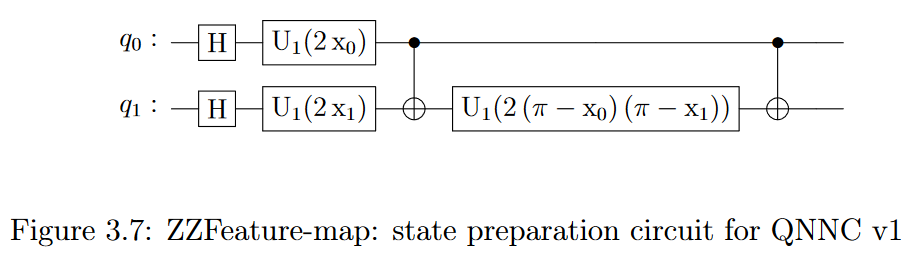 - Apply a Hadamard gate to each qubit, leaving it in a superposition. - Apply $U_1(2x_0)$ gate to $|q_0\rangle$ and $U_1(2x_1)$ gate to $|q_1\rangle$. - Apply a $cX$ gate with $|q_1\rangle$ as target and $|q_0\rangle$ as control. - Apply a $U_1(\lambda)$ where $\lambda = 2(\pi - x_0)(\pi - x_1)$. - Lastly, apply a $cX$ gate as in the second step. Where $U_1(\lambda) = \begin{pmatrix} 1 & 0 \\ 0 & e^{i\lambda} \end{pmatrix}$ , $\{x_0,x_1\}$ are two features that represent the input $x$. - [ ] How to generate quantum kernel/operator, Lu Shun #### amplitude encoding https://pennylane.ai/qml/glossary/quantum_embedding ## Circuit Design ### QuantumFlow A co-design framework of neural networks and quantum circuits towards quantum advantage, nature communication, 2021 *Insight* Mapping specially designed neural network to quantum circuit. ### QuantumSEA *Key Insight* Sparse topology (i.e., the way to prune gates?) changes each time the weights are updated. ## LLM References 1. https://thequantuminsider.com/2023/02/13/how-could-quantum-computing-improve-large-language-models/ 2. https://medium.com/@thomasjmartin/quantum-computing-and-the-future-of-large-language-models-such-as-chatgpt-38de0028c462 QNLP Resources 1. https://cqcl.github.io/lambeq/examples/circuit.html (lambeq, transform sentence -> diagrams -> circuit ) ## Quantum Vision Transformer http://arxiv.org/abs/2209.08167 ***Background*** Data loader for 1-dimensional vector **Definition:** [Nearest centroid classification on a trapped ion quantum computer, NPJ Quantum](https://www.nature.com/articles/s41534-021-00456-5) A data loader is a procedure that, given access to a classical data point $$ x = (x_1,x_2,\dots,x_d) \in \mathbb{R}^d $$ outputs a parametrized quantum circuit that prepares quantum states of the form $$ \frac{1}{||x||}\sum_{i=1}^d x_i|i\rangle $$ 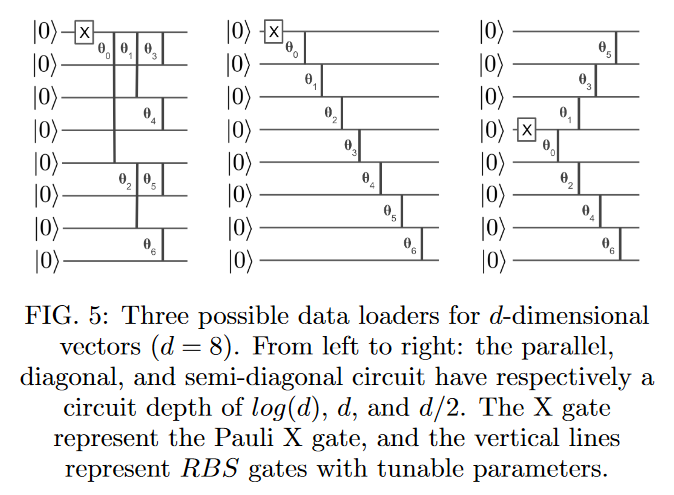 $d=8$-dimensional vector is encoded using 8 qubits? There are 64 basis states: $|00000000\rangle,|00000001\rangle,\dots,|11111111\rangle$ Only 8 states: $|00000001\rangle, |00000010\rangle, \dots,|10000000\rangle$ are used. ***QUANTUM DATA LOADERS FOR MATRICES*** Give a matrix $X\in\mathbb{R}^{n\times d}$, we want to load it in a quantum state. $$ |X\rangle = \frac{1}{||X||} \sum_{i=1}^n \sum_{j=1}^d |e_i\rangle |e_j\rangle $$  ***QUANTUM ORTHOGONAL LAYERS*** A quantum orthogonal layer is defined as a quantum circuit applied on a state $|x\rangle$ (encoded in the *unary* basis) to produce the output state $|Vx\rangle$. Where $V$ is the matrix corresponding to the unitary of the quantum orthonormal layer. 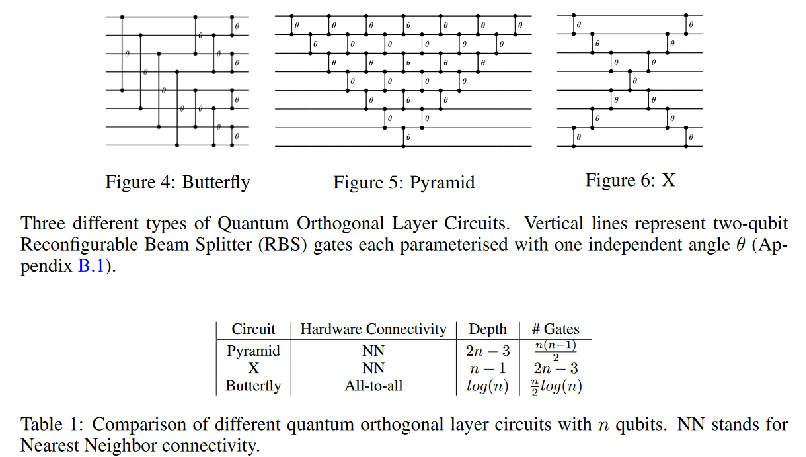 $$ RBS(\theta) = \begin{pmatrix} 1 & 0 & 0 & 0 \\ 0 & \cos \theta & \sin\theta & 0 \\ 0 & -\sin\theta & \cos\theta & 0 \\ 0 & 0 & 0 & 1 \end{pmatrix} $$ 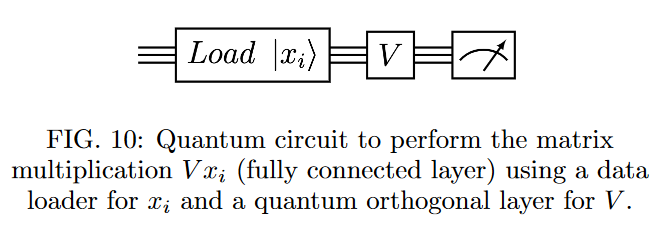 Parameterised quantum circuits are specifically designed to learn the attention coefficients $$ A_{ij} = x_i^T W x_j $$ Three different approaches for implementing the quantum attention layer are introduced *QUANTUM ORTHOGONAL TRANSFORMER* 1. Load $x_j$ into circuit using a vector loader 2. Apply a trainable quantum orthonormal layer $W$ 3. Apply an inverse vector loader of $x_i$. Then the probability of measuring 1 on the first qubit is exactly $|x_i^TWx_j|^2=A_{ij}^2$. ------ $$ U|1\rangle = |x_i\rangle \to \langle 1|U^\dagger = \langle x_i| $$ $$ |1\rangle \langle 1| UWx_j = |1\rangle (\langle 1|U^\dagger)Wx_j = |1\rangle x_i^TWx_j $$ ------ ***Comparison*** Each classical attention layer requires $2d^2$ free parameters.  ## Dataset QM7-X: https://arxiv.org/pdf/2006.15139.pdf ## Ideas ***Encoding*** Encoding $2^n$-dimentional vector using $n$ qubits. 1. Construct unitary: see QC and QI exercise 2.7 2. Unitary synthesis -> encoding circuit. ***On-chip Training*** [Nelder–Mead method](https://en.wikipedia.org/wiki/Nelder%E2%80%93Mead_method) <!--stackedit_data: eyJoaXN0b3J5IjpbLTEwNzQ5MjM2MzksMTc4MzA5NTkwOSwxNj EwODEzMjIzLC0xMjAwNTQ4MjExXX0= --> -
Sep 12, 2023 . 1 changed file with 20 additions and 1 deletion.There are no files selected for viewing
This file contains hidden or bidirectional Unicode text that may be interpreted or compiled differently than what appears below. To review, open the file in an editor that reveals hidden Unicode characters. Learn more about bidirectional Unicode charactersOriginal file line number Diff line number Diff line change @@ -9,6 +9,24 @@ Some evidence or verbal trick to illustrate the potential of quantum application ## VQA Basis ### Parameter Shift ```python def shift_and_run(model, inputs, use_qiskit=False): param_list = [] for param in model.parameters(): param_list.append(param) grad_list = [] for param in param_list: param.copy_(param + np.pi * 0.5) out1 = model(inputs, use_qiskit) param.copy_(param - np.pi) out2 = model(inputs, use_qiskit) param.copy_(param + np.pi * 0.5) grad = 0.5 * (out1 - out2) grad_list.append(grad) return model(inputs, use_qiskit), grad_list ``` ## Machine Learning @@ -326,5 +344,6 @@ The measurement results represent the solutions. - [x] When computing loss function, is it still an exponential size problem? <!--stackedit_data: eyJoaXN0b3J5IjpbMTc4MzA5NTkwOSwxNjEwODEzMjIzLC0xMj AwNTQ4MjExXX0= --> -
Aug 28, 2023 . 1 changed file with 4 additions and 1 deletion.There are no files selected for viewing
This file contains hidden or bidirectional Unicode text that may be interpreted or compiled differently than what appears below. To review, open the file in an editor that reveals hidden Unicode characters. Learn more about bidirectional Unicode charactersOriginal file line number Diff line number Diff line change @@ -7,6 +7,9 @@ Some evidence or verbal trick to illustrate the potential of quantum application - “A glimpse of the quantum future” - As the hardware matures according to goals laid out in IBM Quantum’s hardware roadmap, the researchers expect to demonstrate a clear advantage over the classical competition. ## VQA Basis ## Machine Learning <img width="660" alt="image" src="https://user-images.githubusercontent.com/40353317/203234884-3b44f60e-76b5-49c8-8871-06d5baef0461.png"> @@ -323,5 +326,5 @@ The measurement results represent the solutions. - [x] When computing loss function, is it still an exponential size problem? <!--stackedit_data: eyJoaXN0b3J5IjpbMTYxMDgxMzIyMywtMTIwMDU0ODIxMV19 --> -
Aug 28, 2023 . 1 changed file with 3 additions and 0 deletions.There are no files selected for viewing
This file contains hidden or bidirectional Unicode text that may be interpreted or compiled differently than what appears below. To review, open the file in an editor that reveals hidden Unicode characters. Learn more about bidirectional Unicode charactersOriginal file line number Diff line number Diff line change @@ -322,3 +322,6 @@ The measurement results represent the solutions. - [ ] Why construct circuit like this? - [x] When computing loss function, is it still an exponential size problem? <!--stackedit_data: eyJoaXN0b3J5IjpbLTEyMDA1NDgyMTFdfQ== --> -
Aug 28, 2023 . 2 changed files with 324 additions and 1 deletion.There are no files selected for viewing
This file contains hidden or bidirectional Unicode text that may be interpreted or compiled differently than what appears below. To review, open the file in an editor that reveals hidden Unicode characters. Learn more about bidirectional Unicode charactersOriginal file line number Diff line number Diff line change @@ -1 +0,0 @@ This file contains hidden or bidirectional Unicode text that may be interpreted or compiled differently than what appears below. To review, open the file in an editor that reveals hidden Unicode characters. Learn more about bidirectional Unicode charactersOriginal file line number Diff line number Diff line change @@ -0,0 +1,324 @@ # Applications Some evidence or verbal trick to illustrate the potential of quantum applications. - Though in their infancy, the stability of qubits should become much better over time. -- [IBM](https://www.ibm.com/case-studies/daimler/) - As IBM’s quantum hardware scales rapidly – from small prototype systems to more promising larger devices – researchers are excited about the possibility to one day handle previously insoluble routing problems. - “A glimpse of the quantum future” - As the hardware matures according to goals laid out in IBM Quantum’s hardware roadmap, the researchers expect to demonstrate a clear advantage over the classical competition. ## Machine Learning <img width="660" alt="image" src="https://user-images.githubusercontent.com/40353317/203234884-3b44f60e-76b5-49c8-8871-06d5baef0461.png"> ***Refs*** 1. https://qiskit.org/textbook/ch-machine-learning/machine-learning-qiskit-pytorch.html#Contents 2. https://qulearn.baidu.com/textbook/chapter5/%E9%87%8F%E5%AD%90%E5%88%86%E7%B1%BB%E5%99%A8.html ***Brief*** 1. Classical data $\to$ quantum states (quantum data). 1. Quantum Variational Circuit (QPU) 1. Measure output and compute loss ## Chemistry Case: [Quantum Chemistry with Qu&Co’s (now Pasqal) QUBEC on Amazon Braket](https://aws.amazon.com/cn/blogs/quantum-computing/quantum-chemistry-with-qucos-qubec-on-amazon-braket/) "To set expectations correctly, so far, **no variational quantum algorithm has outperformed classical supercomputers in computational chemistry based on first principles (ab initio)**. However, recently quantum advantage has been demonstrated on a theoretical sampling task,[4] and an increasing number of academic and industrial works are bringing down the resource requirements, devising better quantum circuit strategies and more efficient optimization protocols. The race is on, and many believe chemistry or materials science applications to be one of the candidates to show early examples of industry relevant quantum advantage on near-term hardware." ### Papers - [Evaluating the evidence for exponential quantum advantage in ground-state quantum chemistry (Nature-Comm 2023, CalTech)](https://www.nature.com/articles/s41467-023-37587-6) ## Quantum Simulation Reference: https://qml.baidu.com/tutorials/quantum-simulation/hamiltonian-simulation-with-product-formula.html ### Utilize Product Formula To Simulate Time Evolution According to one of the fundamental axioms of quantum mechanics, the evolution of a system over time can be described by $$ i\hbar\frac{\delta}{\delta t}|\psi\rangle = H|\psi\rangle $$ $\hbar$ is the reduced Planck constant. This equation is the well-known Schrödinger equation. Thus, for a time independent Hamiltonian, the time evolution equation of the system can be written as $$ |\psi(t)\rangle = U(t)|\psi(0)\rangle, U(t) = e^{-iHt} $$ Here we take the natural unit $\hbar = 1$ and $U(t)$ is the time evolution operator. The idea of simulating the time evolution process with quantum circuits is to approximate this time evolution operator using the unitary transformation constructed by quantum circuits. ***Sample Question*** For the Hamiltonian $H = I\otimes X + 0.5I\otimes Z - 0.2X\otimes X + 1.2Z\otimes I + 0.5Z\otimes Z$, find a quantum circuit $U$ to simulate $e^{-iH}$ with error tolerance 0.01 (i.e., $||U - e^{-iH}||\leq 0.01$). Moreover, try to use the idea of variational quantum circuit compiling to simplify the circuits. ## Optimization ### QAOA * [A Quantum Approximate Optimization Algorithm](https://arxiv.org/pdf/1411.4028.pdf) #### Huawei [Intro from Huawei Mindspore](https://mindspore.cn/mindquantum/docs/zh-CN/master/quantum_approximate_optimization_algorithm.html) <img width="755" alt="image" src="https://user-images.githubusercontent.com/40353317/200154385-241ea4ed-1020-4fe3-9ba3-fcd51005030a.png"> <img width="758" alt="image" src="https://user-images.githubusercontent.com/40353317/200154409-60335dbb-d434-415a-8c24-fbfc8fa4fcaa.png"> <img width="752" alt="image" src="https://user-images.githubusercontent.com/40353317/200155030-b4078a94-83e8-4716-96c1-1bd80c339a87.png"> <img width="751" alt="image" src="https://user-images.githubusercontent.com/40353317/200155044-0c84a8b5-74d7-4b54-b808-a3f64a901d67.png"> #### Google [qaoa-maxcut](https://quantumai.google/cirq/experiments/qaoa/qaoa_maxcut) #### IBM [qaoa](https://qiskit.org/documentation/optimization/tutorials/06_examples_max_cut_and_tsp.html) "It is important to say that, given the classical nature of combinatorial problems, exponential speedup in using quantum computers compared to the best classical algorithms is not guaranteed." #### Baidu [Intro from Baidu](https://qulearn.baidu.com/textbook/chapter5/%E9%87%8F%E5%AD%90%E8%BF%91%E4%BC%BC%E4%BC%98%E5%8C%96%E7%AE%97%E6%B3%95.html#%E7%A4%BA%E4%BE%8B%EF%BC%9Aqaoa-%E6%B1%82%E8%A7%A3%E6%9C%80%E5%A4%A7%E5%89%B2%E9%97%AE%E9%A2%98) ##### Combinatorial Optimization Consists of $n$ bits and $m$ clauses. Each clause ( $C$ ) is a constraints for part of bits. Here $z$ represents the bit series $z_{1} z_{2} \dots z_{n}$ $$ C_j(z) = \begin{cases} 1 & \text{if clause $j$ is satisfied} \\ 0 & \text{if clause $j$ is not satisfied} \end{cases} $$ We have the objective function: $$ C(z) = \sum_{j=1}^{m}{w_j C_j(z)} $$ Objective: find $z$ that maximize $C(z)$ ##### Quantum Approximation Optimization Algorithm (QAOA) "对于一个问题,如果我们找到了它的哈密顿量,根据这个哈密顿量我们可以求得它的本征态和本征能量,得到了本征态和本征能量就相当于解决了这个问题" -- [本源量子视频](https://www.bilibili.com/video/BV124411b7bd?p=4&vd_source=fcea60793570e354598363f4123c0d15) Transform to an optimization problem on quantum system. Consider a compute basis $|z\rangle \in \lbrace0,1\rbrace^n$. Define the Hamiltonian as: $$ H_{C_j}|z\rangle = C_j(z)|z\rangle $$ Where the Hamiltonian can be constructed as: $$ H_{C_j} = \sum_{z\in \{0,1\}^n}{C_j(z)|z\rangle \langle z|} $$ Why? $$ \langle z'| z\rangle = \begin{cases} 1 & \text{if } z' = z \\ 0 & \text{else} \\ \end{cases} $$ So $\sum_{z'\in \{0,1\}^n}{C_j(z')|z'\rangle \langle z'|} z\rangle = C_j(z)|z\rangle$ For example, consider we have $z^{(1)}$ and $z^{(2)}$ that satisfy $C_j$, the the Hamiltonian is: $$ H_{C_j}=|z^{(1)}\rangle \langle z^{(1)}|+| z^{(2)}\rangle \langle z^{(2)}| . $$ To this end, QAOA encodes the objective function $C$ into a $n$-Qubit quantum system's Hamiltonian. $$ H_C=\sum_{j=1}^m w_j H_{C_j}, $$ Which satisfy the eigen equation: $$ H_C|z\rangle=\sum_{j=1}^m w_j H_{C_j}|z\rangle=\sum_{j=1}^m w_j C_j(z)|z\rangle=C(z)|z\rangle $$ Notice that, assume the optimal solution is $z_{\text{opt}}$, we have: $$ \left\langle z_{\mathrm{opt}}\left|H_C\right| z_{\mathrm{opt}}\right\rangle=\left\langle z_{\mathrm{opt}}\left|C\left(z_{\mathrm{opt}}\right)\right| z_{\mathrm{opt}}\right\rangle=C\left(z_{\mathrm{opt}}\right)\left\langle z_{\mathrm{opt}} \mid z_{\mathrm{opt}}\right\rangle=C\left(z_{\mathrm{opt}}\right) $$ Thus the optimal solution is the ***eigenvector*** of the Hamiltonian with the ***maximum eigenvalue*** ( $C_{max}$ ) For arbitrary quantum state $\psi$, we have: $$ \langle \psi | H_C |\psi \rangle \leq C(z_{\text{opt}}) $$ Why? Because: $$|\psi \rangle = \sum_i^n{c_i|z_i\rangle}, \sum_i^n{|c_i|^2} = 1$$ Therefore: $$ \begin{aligned} \langle \psi | H_C |\psi \rangle &= \sum_{i}^{n}{c_i^* \langle z_i|} H_C \sum_{i}^{n}{c_i|z_i\rangle} \\ &= \sum_{i}^{n}{c_i^* \langle z_i|}\sum_{i}^{n}{c_i H_{C}|z_i\rangle} \\ &= \sum_{i}^{n}{c_i^* \langle z_i|}\sum_{i}^{n}{c_i C(z_i)|z_i\rangle} \\ &= \sum_{i}^{n}{C(z_i) c_i^*c_i \langle z_i|z_i \rangle} \\ &= \sum_{i}^{n}{|c_i|^2 C(z_i)} \\ &\leq \sum_{i}^{n}{|c_i|^2 C(z_{\text{opt}})} = C(z_{\text{opt}}) \end{aligned} $$ ##### Max-cut Problem 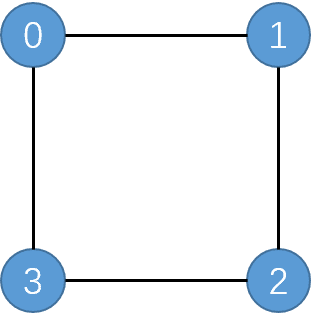 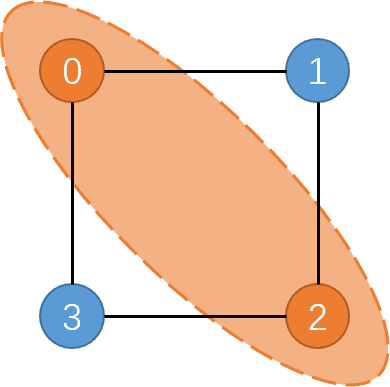 For a graph $G = (V,E)$, we have $n = |V|$ vertexes and $m = |E|$ edges. For each vertex $v$ in $G$, the value $z_v$ is 0 or 1 (0, 1 represent two partitions). For each edge $E = (u,v)$. A "clause" requires that $z_u \neq z_v$, meaning that vertex $v$ and $u$ are divided into different sub-sets. For each edge in the graph we have (XOR): $$ C_(u,v)(z) = z_u + z_v - 2z_u z_v $$ Note that only $z_u \neq z_v$ results in 1, otherwise 0. The entire problem is: $$ C(z) = \sum_{(u,v)\in E}{C_(u,v)(z)}=\sum_{(u,v)\in E}{z_u + z_v - 2z_u z_v} $$ ##### QAOA encoding [Hamiltonian](https://zh.wikipedia.org/zh-cn/%E5%93%88%E5%AF%86%E9%A1%BF%E7%AE%97%E7%AC%A6) $$ Z\equiv \begin{bmatrix} 1 & 0 \\ 0 & -1 \end{bmatrix} \\ Z|0\rangle = |0\rangle \\ Z|1\rangle = -|1\rangle $$ Using $Z$ gate to construct Hamiltonian of the system. (Use mapping: $f(x)\rightarrow\frac{1-x}{2}$) $$ \begin{aligned} H_C &= \sum_{(u,v)\in E}{C_(u,v)(z)} = \sum_{(u,v)\in E}{\frac{I-Z_u}{2} + \frac{I-Z_v}{2} - 2 \frac{I-Z_u}{2} \frac{I-Z_v}{2}} \\ &= \sum_{(u,v)\in E}{\frac{2I - Z_u - Z_v - (Z_u Z_v - Z_u - Z_v + I)}{2}} \\ &= \sum_{(u,v)\in E}{\frac{I - Z_u Z_v}{2}} \end{aligned} $$ ------ Why? $$ \begin{aligned} H_C |z\rangle &= \sum_{(u,v)\in E}{\frac{I - Z_u Z_v}{2} |z\rangle} \\ &= \sum_{(u,v)\in E}{\frac{|z_0\rangle \otimes \cdots \otimes (I - Z_u Z_v) |z_u z_v\rangle \otimes \cdots \otimes |z_n\rangle }{2}} \end{aligned} $$ Note that (according to equition 71): $$ Z_u Z_v |z_u z_v\rangle = \begin{cases} -|z_u z_v\rangle & \text{if } z_u \neq z_v \\ |z_u z_v\rangle & \text{if } z_u = z_v \end{cases} $$ Here $$ \begin{aligned} Z_u Z_v | z_u z_v \rangle &\equiv (Z_u \otimes Z_v) (z_u \otimes z_v) \\ &= Z_u|z_u\rangle \otimes Z_v|z_v\rangle \end{aligned} $$ Thus: $$ \frac{|z_0\rangle \otimes \cdots \otimes (I - Z_u Z_v) |z_u z_v\rangle \otimes \cdots \otimes |z_n\rangle }{2} = \begin{cases} |z\rangle & \text{if } z_u \neq z_v \\ 0 & \text{if } z_u = z_v \end{cases} $$ Therefore $$ \begin{aligned} H_C |z\rangle = \sum_{(u,v)\in E}{(z_u + z_v - 2z_u z_v)|z\rangle} \end{aligned} $$ ------ The expectation of $H_C$ with state $\psi$ is: $$ \begin{aligned} \langle\psi|H_C| \psi\rangle &=\langle\psi|\sum_{(u, v) \in E} \frac{I-Z_u Z_v}{2}| \psi\rangle \\ &=\langle\psi|\sum_{(u, v) \in E} \frac{I}{2}| \psi\rangle-\langle\psi|\sum_{(u, v) \in E} \frac{Z_u Z_v}{2}| \psi\rangle \\ &=\frac{|E|}{2}-\frac{1}{2}\langle\psi|\sum_{(u, v) \in E} Z_u Z_v| \psi\rangle . \end{aligned} $$ Denote $H_D = -\sum_{(u, v) \in E} Z_u Z_v$, we need find $|\psi\rangle$ to maximize $\langle \psi| H_D | \psi \rangle$ ##### How to construct the Quantum Circuit $$ U_B\left(\beta_p\right) U_D\left(\gamma_p\right) \cdots U_B\left(\beta_1\right) U_D\left(\gamma_1\right), $$ Tune $\beta$ and $\gamma$ to find the optimal $| \psi (\beta, \gamma)\rangle$. The following figure is an implementation of $U_B(\beta)U_D(\gamma)$. 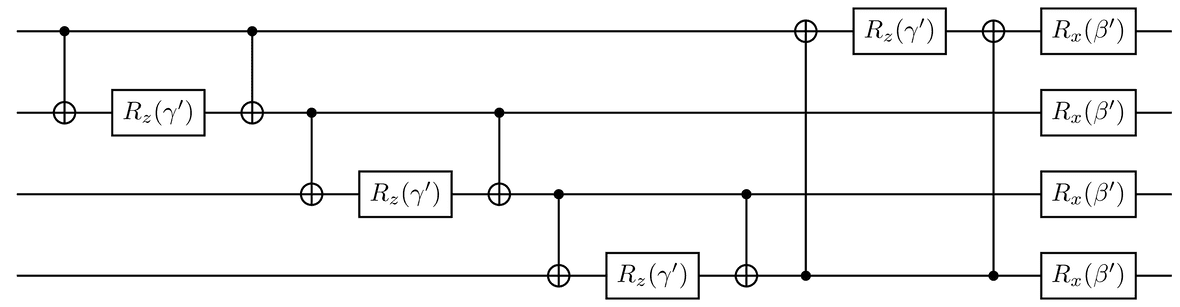 1. Construct the parameterized circuit. 2. Run the circuit to get output $\psi (\beta, \gamma)$. 3. Compute the cost function $C$ and optimize the parameters using classical optimizer. The measurement results represent the solutions.  #### Summary * Smaller expectation means more qubits connected by an edge have different quantum state, i.e., more edges have been cut. - [ ] Why construct circuit like this? - [x] When computing loss function, is it still an exponential size problem?
NewerOlder