Skip to content

Instantly share code, notes, and snippets.

View xslattery's full-sized avatar

Xavier Slattery xslattery

View GitHub Profile
#include <windows.h>
#include <stdio.h>
typedef struct ldr_data_entry
{
LIST_ENTRY LinkedList;
LIST_ENTRY UnusedList;
PVOID BaseAddress;
PVOID Reserved2[1];
@mmozeiko
mmozeiko / wic.h
Last active August 7, 2025 06:17
simple wrapper to load or save D3D11 texture from/to image file with Windows Imaging Component
#pragma once
#define COBJMACROS
#include <windows.h>
#include <d3d11.h>
//
// interface
//
@mmozeiko
mmozeiko / _miniperf_readme.md
Last active February 6, 2026 05:43
get PMU counter values with ETW, perf or kperf

MiniPerf

Example of how to capture CPU counters with ETW on Windows, perf on Linux or kperf on Apple.

Using ETW needs somewhat recently updated Windows 10 or 11. Not sure about exact version.

Currently tested on:

  • etw on Qualcomm Snapdragon X Elite, Windows 11, arm64
  • etw on AMD Zen 3, Windows 11 (with virtualization enabled in BIOS)
@ibireme
ibireme / kpc_demo.c
Last active March 13, 2026 21:50
A demo shows how to read Intel or Apple M1 CPU performance counter in macOS.
// =============================================================================
// XNU kperf/kpc demo
// Available for 64-bit Intel/Apple Silicon, macOS/iOS, with root privileges
//
//
// Demo 1 (profile a function in current thread):
// 1. Open directory '/usr/share/kpep/', find your CPU PMC database.
// M1 (Pro/Max/Ultra): /usr/share/kpep/a14.plist
// M2 (Pro/Max): /usr/share/kpep/a15.plist
// M3: /usr/share/kpep/as1.plist
@d7samurai
d7samurai / .readme.md
Last active March 18, 2026 03:14
Minimal D3D11

Minimal D3D11

Minimal D3D11 reference implementation: An uncluttered Direct3D 11 setup + basic rendering primer and API familiarizer. Complete, runnable Windows application contained in a single function and laid out in a linear, step-by-step fashion that should be easy to follow from the code alone. ~200 LOC. No modern C++, OOP or (other) obscuring cruft. View on YouTube

hollowcube

Other gists in this series:

//
// Author: Jonathan Blow
// Version: 1
// Date: 31 August, 2018
//
// This code is released under the MIT license, which you can find at
//
// https://opensource.org/licenses/MIT
//
//
@pervognsen
pervognsen / x64_emitter.cpp
Created May 14, 2016 20:31
x64 machine code emitter
#define _CRT_SECURE_NO_WARNINGS
#include <stdio.h>
#include <windows.h>
#include <stdint.h>
#define Assert(x) \
if (!(x)) { MessageBoxA(0, #x, "Assertion Failure", MB_OK); __debugbreak(); }
enum Register {
RAX = 0,
@rygorous
rygorous / gist:e0f055bfb74e3d5f0af20690759de5a7
Created May 8, 2016 06:54
A bit of background on compilers exploiting signed overflow
Why do compilers even bother with exploiting undefinedness signed overflow? And what are those
mysterious cases where it helps?
A lot of people (myself included) are against transforms that aggressively exploit undefined behavior, but
I think it's useful to know what compiler writers are accomplishing by this.
TL;DR: C doesn't work very well if int!=register width, but (for backwards compat) int is 32-bit on all
major 64-bit targets, and this causes quite hairy problems for code generation and optimization in some
fairly common cases. The signed overflow UB exploitation is an attempt to work around this.
@gtallen1187
gtallen1187 / slope_vs_starting.md
Created November 2, 2015 00:02
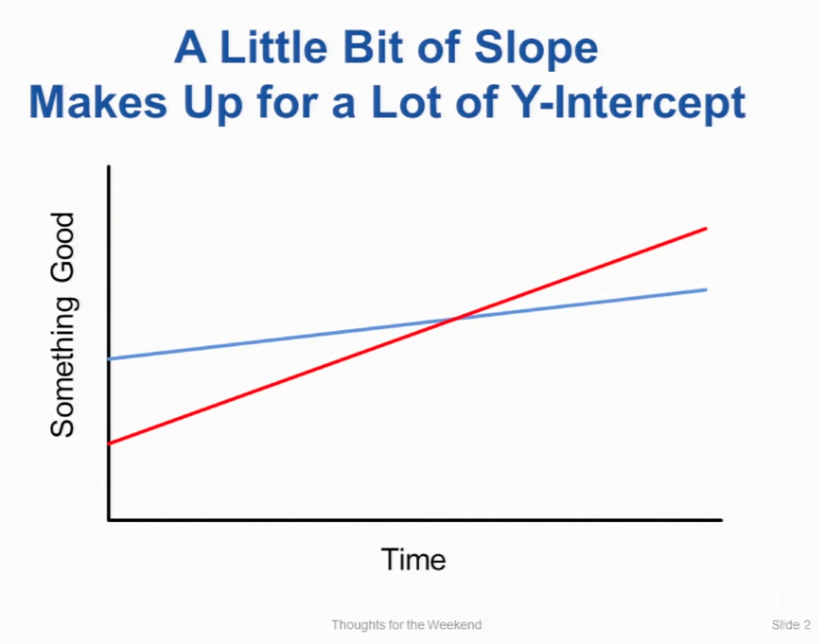
A little bit of slope makes up for a lot of y-intercept

"A little bit of slope makes up for a lot of y-intercept"

01/13/2012. From a lecture by Professor John Ousterhout at Stanford, class CS140

Here's today's thought for the weekend. A little bit of slope makes up for a lot of Y-intercept.

[Laughter]

#pragma comment(lib, "Xinput.lib")
#include <stdio.h>
#include <stdlib.h>
#include <string.h>
#define WIN32_LEAN_AND_MEAN
#include <windows.h>
#include <Xinput.h>