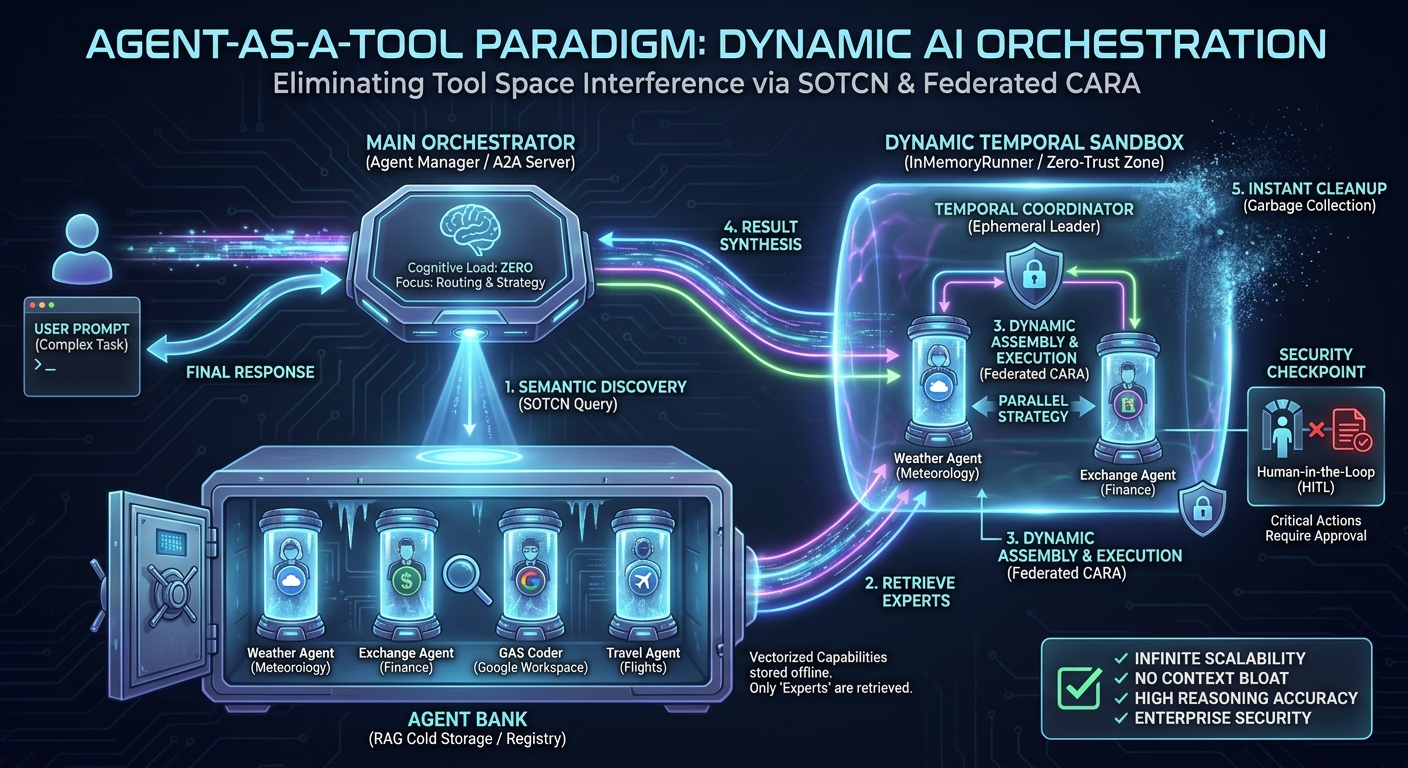
As Large Language Model (LLM) agents increasingly integrate numerous external systems, they suffer from Tool Space Interference (TSI), a phenomenon causing context bloat, attention dilution, and degraded reasoning accuracy. In this paper, we introduce the Agent-as-a-Tool paradigm—an evolutionary, practical implementation of the recently proposed Self-Optimizing Tool Caching Network (SOTCN) and Federated Context-Aware Routing Architecture (Federated CARA). By leveraging Retrieval-Augmented Generation (RAG) to dynamically discover and assemble stateful, autonomous sub-agents on the fly, this architecture completely eliminates TSI, enforces Zero-Trust execution boundaries, and achieves infinitely scalable AI orchestration.

Kanshi TANAIKE tanaikech
A Comparative Study of Agentic Frameworks and Multi-Agent Orchestration
The transition from passive chatbots to autonomous execution environments was cemented at Google Cloud Next '26 with the introduction of the Gemini Enterprise Agent Platform. This paper evaluates four cutting-edge AI agent methodologies for Google Workspace automation, developed by leading developers Martin Hawksey, Bruce Mcpherson, and Kanshi Tanaike. We deconstruct their structural approaches—CLI skill chaining, advanced emulation sandboxing, dynamic code generation, and A2A remote delegation—demonstrating how these community-driven innovations anticipated native Next '26 features like the official Agent Skills repository and Model Context Protocol (MCP) support. Building upon these foundations, we propose two novel frameworks: the Federated Context-Aware Routing Architecture (Federated CARA) for zero-trust, multi-cloud task routing, and the Self-Optimizing Tool Caching Ne
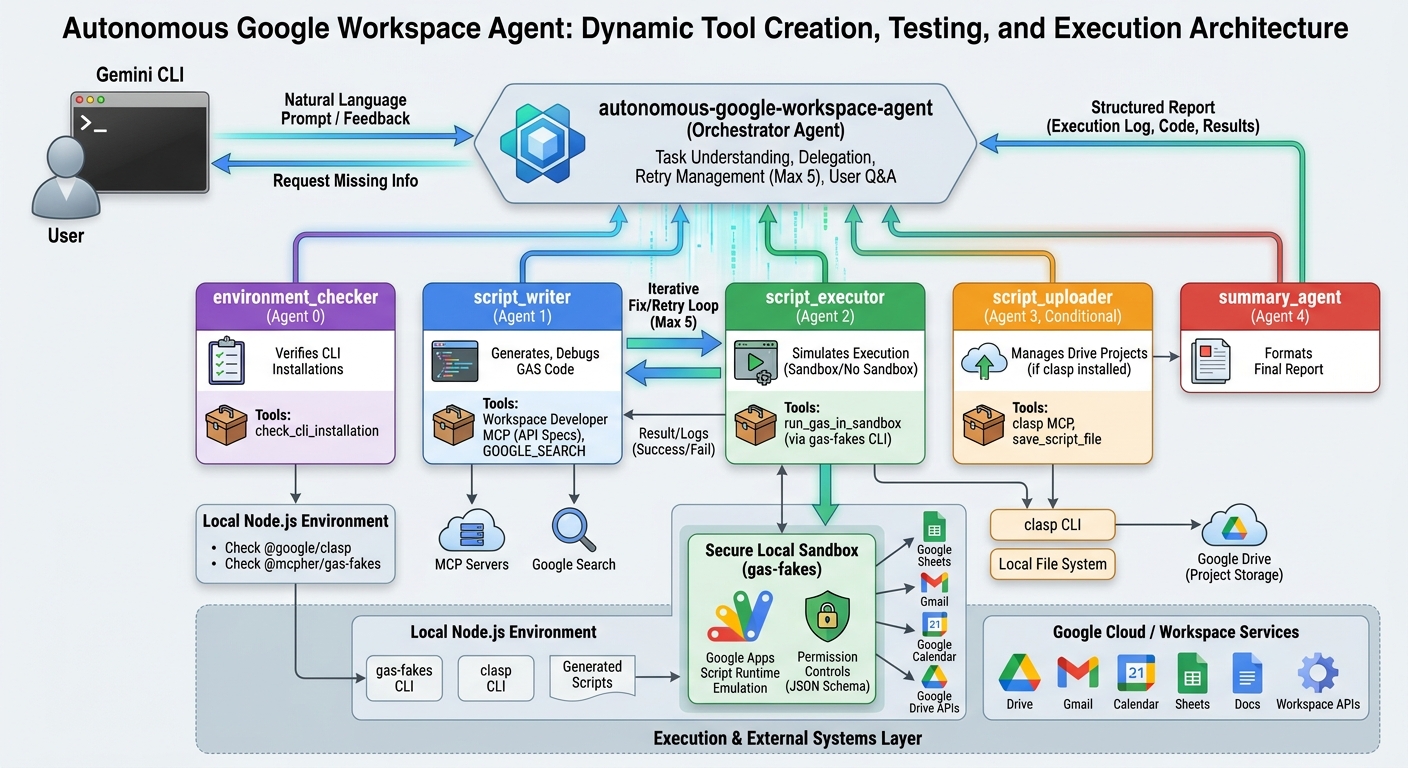
Welcome to the Agentic Enterprise era. This article explores a paradigm shift in generative AI workflows by introducing an autonomous agent capable of dynamically creating, testing, and executing original tools. Utilizing Google Apps Script, Node.js emulation, and multi-agent orchestration, this architecture overcomes traditional limitations, enabling highly adaptable task execution.
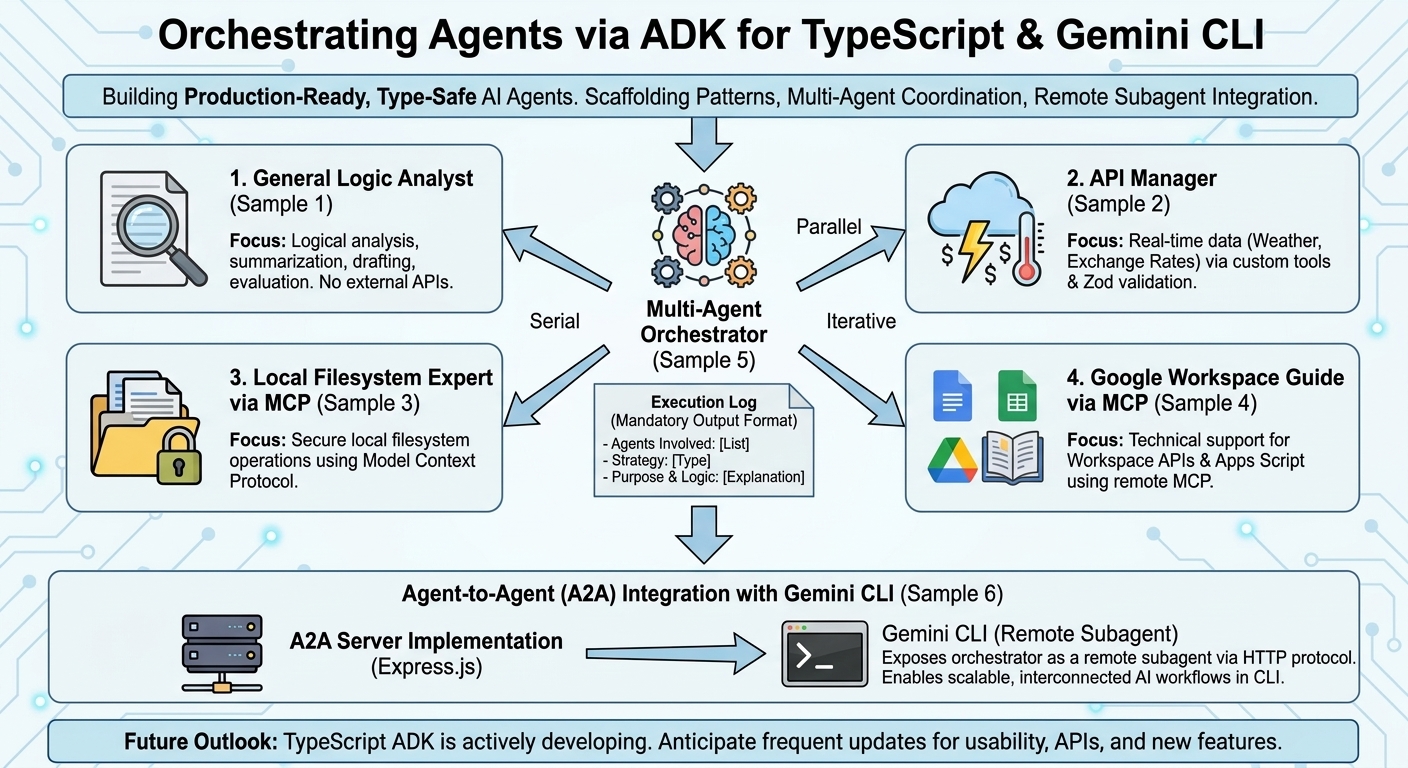
Explore how to build and orchestrate production-ready, type-safe AI agents using Google's TypeScript Agent Development Kit (ADK). This guide provides practical scaffolding patterns, multi-agent coordination strategies, and seamless integration techniques for deploying remote subagents within the Gemini CLI ecosystem.

This article explores integrating remote subagents built with Google Apps Script into the Gemini CLI using the Agent-to-Agent (A2A) protocol. It demonstrates how bypassing standard authentication via local agent cards enables seamless execution of complex workflows while effectively overcoming Tool Space Interference (TSI) for massive toolsets.
Google Sheets recently introduced the SHEET and SHEETS functions. Because they automatically recalculate upon structural changes, developers can utilize them as custom triggers. This article demonstrates how to leverage these functions to detect sheet insertions, deletions, renames, and movements without requiring cumbersome installable triggers in Google Apps Script.
On February 23, 2026, Google introduced two pivotal built-in functions to Google Sheets: SHEET and SHEETS Ref. The SHEET function returns the index (sheet number) of a specified sheet or reference Ref. Meanwhile, the SHEETS function provides the total count of sheets within a spreadsheet Ref.
Recursive Knowledge Crystallization: Enabling Persistent Evolution and Zero-Shot Transfer in AI Agents
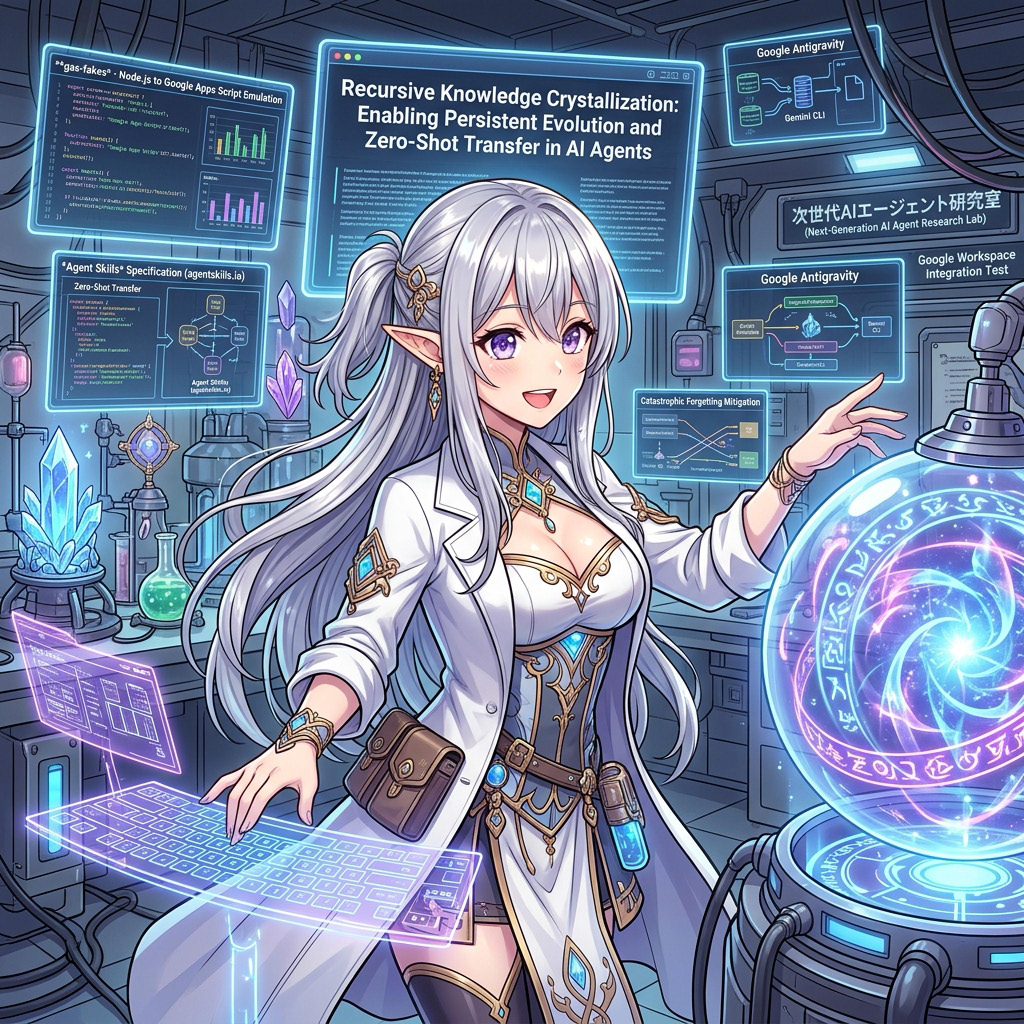
This paper presents a self-evolving framework, Recursive Knowledge Crystallization (RKC), designed to overcome the "Catastrophic Forgetting" inherent in autonomous AI agents. By persisting evolved technical insights into a universally readable SKILL.md file based on the Agent skills specification, this approach establishes long-term memory and cross-platform portability. The framework was empirically validated through the development of gas-fakes, a highly complex Node.js-to-Google Apps Script (GAS) emulation library. The results demonstrate that agents can autonomously internalize project-specific architectural patterns and environmental nuances. Consequently, the framework achieves Zero-Shot Knowledge Transfer across distinct toolcha
Discover how to seamlessly integrate Google Workspace with GitHub Actions using the gas-fakes library. This guide demonstrates running Google Apps Script locally and within CI/CD pipelines without deploying Web Apps. Automate workflows, secure credentials, and effortlessly interact with Google Drive and Sheets directly from your repository.

In the development of autonomous agents using Large Language Models (LLMs), restrictions such as context window limits and session fragmentation pose significant barriers to the long-term accumulation of knowledge. This study proposes a "self-evolving framework" where an agent continuously records and refines its operational guidelines and technical knowledge—referred to as its SKILL—directly onto a local filesystem in a universally readable format (Markdown). By conducting experiments across two distinct environments featuring opaque constraints and complex legacy server rules using Google's Antigravity and Gemini CLI, we demonstrate the efficacy of this framework. Our findings reveal that the agent effectively evolves its SKILL through iterative cycles of trial and error, ultimately saturating its learning. Furthermore, by tr

This is an appendix for https://gist.github.com/tanaikech/da47643a4b59578092f0129a9eb0c9c5, Medium, and DEV.
A.1. Directory Structure
Directory Structure for Antigravity:
NewerOlder