
- General notes
- Initial research
- Learning activities
Total learning time: 1120 hours (±125).
- Reading in several Indo-European languages at varying levels of proficiency. No experience beyond that family except for 2 weeks of Hanzi study 10 years prior.
-
80% reading comprehension.
-
20% listening comprehension.
-
0% output.
For now then, a more accurate title for the document would be How I’ve Been Learning to Understand Japanese.
I’m currently not interested in learning to output. But even if I was, I believe that building an upper-intermediate level reading and listening comprehension might ideally be a pre-requisite for even starting to practice output (unless, of course, one’s under a time constraint to reach a basic communicative level). This also strongly aligns with my personal learning preferences: I find output practice not backed by a significantly more developed comprehension ability painful and unenjoyable.
(Subject to slight modification.)
Base: Have three 30+ minutes long sessions where I read different medium-difficulty light novels on Kindle at a pace exceeding 15k characters per hour.
Extra:
-
Get at least 3/4 of the answers right on N1 practice tests three times in a row.
-
Watch three episodes of different medium-difficulty anime raw with at most three (plus or minus) interruptions (rewinds, lookups) each.
-
Laptop and an external display (running Arch Linux with Sway).
-
Kindle Paperwhite.
-
Smartphone with Android.
Started using it ~950 hours in for web novels and audiobooks.
-
Prioritize maintaining a daily practice over the long-term.
-
Don’t commit to anything I wouldn’t be able to do for a year straight without it turning into a chore.
-
Don’t neglect other interests, exercise, etc.
-
-
Prioritize increasing reading speed and ease.
- This is intended to create a snowball effect: When reading speed and ease increase, you naturally tend to be exposed to greater amounts text of increasing complexity, which promotes further progress in the same direction.
An illustration of what this prioritization can entail:
Assume you have 3 “learning effort points” (a certain quantity of time and mental exertion) to spend on either:
a. all off: (1) learning a rough meaning of a written word, (2) learning how the kanji in the word are pronounced, and (3) explicitly learning the nuanced meaning of the word (as much as this is possible; e.g. by seeking and studying example sentences); or
b. learning a rough meaning of 3 written words.
Given that choice, I’d opt for b., since I believe this promotes pure reading comprehension skill the most, even if it means I have to rely more on context and on guessing (because I only know the rough meanings) and even if it makes me miss more nuance in what I’m reading (better to save works with serious literary value for later).
Reading faster and with more ease is going to increase the number of times I’m exposed to any given word in different contexts (not just because of more characters per hour but also because of the capacity for sustaining increasingly longer reading sessions), and this naturally solves (3). As for learning pronunciations (2), I’d make sure to not completely neglect it even when reading plain text, by occasionally looking up pronunciations of words (though this needs to be properly balanced with reading speed). I’d also slowly acquire them during Anki reviews (pronunciation and audio auto-play on the back of the card), while reading voiced visual novels, and during listening practice.
- Prioritizing reading speed and ease is also a very quick path leading to a point where you have relatively interesting texts you're able to read with such ease that they can replace your regular entertainment. This creates time for learning even at times when you’re tired and a bit busy.
In the beginning, I spent a few hours in total collecting information and ideas from various online guides. This was done in parallel with the early learning activities. Some of the websites I used:
- https://itazuraneko.neocities.org
- https://learnjapanese.moe
- https://animecards.site
- https://tatsumoto.neocities.org
- https://anacreondjt.gitlab.io
Unnecessary disclaimer: Obviously, I don’t recommend accepting uncritically what’s written on those websites, or here.
Done over ~16 months (corresponds to ~75 minutes per day).
The following hour counts were approximated post hoc around hour 600 (also approximate), so they might deviate as much as 25% on average from the actual figures (they don’t even add up to 600).
| Activity | Time (hours) |
|---|---|
| 1. Kick-starting kana reading | 12 |
| 2. Anki | 180 |
| 3. Grammar study | 18 |
| 4. Reading focus | |
| 4.1. Anime subtitles | 110 |
| 4.2. Manga | 55 |
| 4.3. Visual novels | 130 |
| 4.4. Game text | 20 |
| 4.5. Novels | 18 |
| 5.1. Translation-assisted anime listening | 55 |
| 8. Other | 6 |
At around 600 total hours of learning time (post-hoc approximation), I began recording study time to keep myself accountable for at least 60 minutes every day.
I maintain a single daily tally of minutes spent on Japanese in a text file I use for general daily notes. At the end of each day, the figure is rounded to the nearest 5 and archived under the given date. Those daily time counts are what I use for the total learning time approximations (past 600 hours) in this document.
The rule for counting time is: I’m either paying attention to Japanese text/speech or I’m only having a brief and reasonably justifiable break from that (e.g. glancing at the drawings in a manga, getting momentarily lost in thought when listening to an audiobook while generally paying attention, pausing to reflect on the content of the text for a few seconds, mining a word, speedreading an English subtitle while doing the “translation-assisted listening” method, and so on). On the other hand, the following are some examples of the kinds of situations where I generally do try to deduct the time spent in them: – anime themes, – not paying attention half of the time when listening to an audiobook, – in games, sequences that include little novel text (e.g. battles), – getting derailed into a 5-minute mental digression when reading a book.
Time recording methods used (the above-explained deductions apply):
Anki The “Studied X cards for Y minutes today” message.
Video The total time mpv has been
running for, which appears in my terminal upon exiting the process.
Visual novels, games, manga The session time counter in
Kamite.
Plain text (PC) The
Timer browser extension.
Plain text (Kindle/Phone) The
Simple Time Tracker
Android app.
Hours 0–18
↑ Indicates that I started doing this activity just when I began learning
Japanese (hour 0) and dropped it when I was roughly around 18 hours into
learning in terms of total time. Those numbers very approximate (±25% on
average) until hour 600.
I spent some of the initial evening and the following two days of learning going fully through the Tofugu hiragana and katakana courses (including doing all the worksheets). I used mnemonics for all the base characters. Where the Tofugu mnemonics weren’t sticking, I would Google for alternative ones or come up with my own.
Throughout the following week, I did the Tofugu kana quiz a few times. After that, I stopped all deliberate kana practice.
Hours 10–80
To begin reading compelling native material, even with high amount of assistance from a dictionary and from translations, you must be able to recognize the most common words. I’ve used the Anki Core 2.3k Version 3 deck for this. My initial new card count was around 30, but that has quickly settled into 10–15 to keep in line with the basic goal of establishing a daily practice maintainable in the long term.
I quickly realized it took a lot of time and effort for me to remember many of the kanji readings and that this effort mostly didn’t contribute to my comprehension of written text, which was what I had decided to prioritize. For this reason, I decided to no longer test myself on the readings and just on the rough meaning. This, however, created an obvious missed chance to grab some low-hanging fruit, namely to use the occassion of Anki reviews to help myself remember those kanji readings that actually did stick relatively easily. This problem has been partially solved in 2.2.1.
At some point, you roughly know enough words to be able to shift your main focus to reading or listening, and you’re increasingly able to learn words purely from that.
After reaching this point myself, I slowly let Anki recede into the background as a support for my vocabulary learning and as a fixed point of daily routine, to leave more time for reading.
Hours 80–225
Around 700 cards into the Core deck, I started slowly mining occasional words to start making that process into a routine. The words would be mined into the same deck and then manually moved to the front of the learning queue before my daily Anki session. I also did a lot of “pseudo-mining”, that is moving still unlearned words present in the Core deck that I’ve encountered in the wild to the front of the learning queue.
To recap the issue: Learning the reading for all cards uses up a significant amount of effort with no positive effect of corresponding size on pure reading comprehension, which is my priority. Not testing the reading on any cards indirectly wastes some effort by not using the occassion of Anki reviews to help myself remember readings that stick initially but could be forgotten unless tested at appropriate intervals, which early on are too short to be covered by slow reading and a small amount of listening.
The solution: Test for reading but only on a selected subset of cards. Progressively expand that subset as more readings begin to stick.
The implementation: When a card is tagged with produce-reading, display a
prompt “Produce the reading!” at the top of the card (both front and back). If
the prompt is present, grade both on the rough meaning and on the reading.
Otherwise, grade only on the former. To help with this, I’ve set up a keyboard
shortcut for quickly tagging the cards during review with the
Tag Toggler (Fork for 2.1) addon.
When do I tag a card with produce-reading?
-
With learning cards, it’s when I know the reading immediately and I’m mostly sure that I’ll be able to retain it with no explicit memorization effort.
-
With regular cards, it’s when the reading spring to mind immediately and the new interval for a Good answer would be 1 month or more. (In that case, however, I press Hard instead to at least somewhat account for the fact that the new interval is calculated for the meaning itself, while from now on it should be for the combination of the meaning and the reading).
- (Hour 1120) I’ve since relaxed the 1 month requirement, partly because I don’t see the new interval while reviewing in AnkiDroid.
The downside: The real recall intervals for meaning and reading are largely separate in the beginning, and they can diverge especially strongly when there’s a disproportion in emphasis between 1) mere written recognition and 2) listening recognition and reading out loud—like in my case. Yet, when testing for both the meaning and the reading on a single card, there’s only a single interval in Anki.
Hours 225–now
New cards for the Vocabulary deck down to 0–5 a day.
-
During one time when I had zero cards in the backlog, I additionally went through a small Kangxi Radicals deck.
-
(Hour 800) I started slowly going through the Common Japanese Names Deck and the Usagi Chan Kanji Phonetics Deck.
-
(Hour 800) Since remembering pronunciations has become easier and I also often enough find myself associating the word’s meaning more readily with the reading than the spelling, and my Anki workload is small, I’m considering enforcing the recall of the reading by default for all new vocabulary cards and all failed vocabulary cards.
-
At this point, I have the
produce-readingalready tag toggled on for 58% of my non-suspended cards.- (Hour 1120) 67%.
-
-
(Hour 800) While it was crucial at the beginning for bootstraping my vocabulary to the minimum level required to read compelling content, I’m not entirely convinced Anki is still especially useful for me from the standpoint of pure vocabulary acquisition compared to just reading and listening. Regardless, I plan to keep using it, if only for those secondary reasons:
-
It serves as a fixed point of stability in my daily routine: – it takes 3 seconds to start doing reps; – there’s a decent pressure not to skip a single day; – I already have the momentum of a 600-day streak keeping me going.
-
It constitutes an activity distinct from reading or listening, introducing variety into the routine, which is always welcome. This resuts in a net positive effect as long as I keep the time spent in Anki low enough to be comfortable even in periods of lower motivation, which I do.
-
-
(Hour 975) I switched to the fsrs4anki scheduler (without any deep justification—simply based on the appearance that it’s likely better than the old algorithm, and being actively developed as well).
-
I lowered the requested retention rate to 85% from the default 90%.
With vocabulary cards, word recognition is tested in isolation, while during reading there’s a broader context available making it easier, which probably means one can be more lenient with the Anki retention rate than in the average studying situation.
-
I applied personalized parameters derived using the provided optimizer based on the last year of reviews on my main vocabulary deck.
-
I rescheduled all my reviews using the FSRS4Anki Helper addon.
This has initially resulted in well over a thousand pending reviews, so I brought it down to a few hundred using the Postpone function of the addon. The amount of daily reviews has returned to normal after a few days.
Postpoining that many cards will mess with the algorithm a bit, but, as I understand it, the negative effect will be reduced if one uses the Advance cards option bit by bit in the following days.
-
Exploring how to determine their proper use.
For the sake of simplicity, I’ll put aside everything having to do with learning pronunciations, even though this could end up affecting the conclusions (due to combined effects).
I will break down acquiring a piece of vocabulary for pure reading comprehension into two facets:
-
I. Forging an association that, upon seeing a written word, causes recall of an existing “network of ideas” reflecting the meaning of the word. (For comfortable reading, this recall must happen reliably, quickly, and effortlessly.)
-
II. Forming the above-mentioned network of ideas associated with the word so that it corresponds to the full actual meaning of the word as much as possible. (The more it corresponds to it, the harder texts one can read with ease, and the more nuance one is able to catch.)
Note that by “meanings of words” we have to designate something that doesn’t encroach too much into the territory of domain knowledge: to know what 二酸化炭素 really refers to, we have to study chemistry, but for the purposes of II., we’re talking just about knowing it means “carbon dioxide” (unless there are distinctions in the usage of the terms between the two languages that carry their own extra content!).
The most immediately obvious point is that in a great number of cases, II. can’t be accomplished through vocab cards (it can only be started there, by “seeding” the basic meaning) but only through ingesting large amounts of content in the language. Which leads to the firm conclusion (we’ll discard immediately some not very attractive alternatives) that immersion has to be an important part of learning to comprehend the written language, and if there’s any merit to supplementing this with vocab cards, it has to be found somewhere else.
Which leaves us with I., and here there are three possibilities:
-
Anki (vocab cards) is markedly more efficient at achieving I. than immersion.
In this case, it’d be beneficial to use Anki for this as much as it can be tolerated but also without sacrificing doing a good amount of immersion (for the sake of II. as well as for other crucial aspects of learning). The correct proportion would depend on the efficiency gap.
-
Anki is roughly as efficient at achieving I. as immersion.
Here, one should only use Anki for this if there are good secondary reasons to do it (examples in the section above), and spend significantly less time on it than on immersion. The reason being that with immersion one is also doing other things essential for learning, such as achieving II., acquiring grammar, acquiring domain knowledge about Japan, and so on.
-
Anki is markedly less efficient at achieving I. than immersion.
In this case, Anki simply shouldn’t be used at all for this purpose, unless one really loves doing it for its own sake.
To make things more difficult from the outset, I think it’s pretty obvious that which of the above obtains might vary according to one’s level and personal dispositions.
To start, I’m close to being convinced, extrapolating from personal experience, that for many of people 1. is likely true in the very beginning. This is because at that level, ingesting compelling content is generally:
-
Already difficult enough in itself: trying to recall single kana one by one, trying to understand the grammar of even the simplest sentences, and on top of that also trying to recognize kanji (which at that point look like random squiggles) and remember their basic meaning for the purposes of I.—all of this seems like too much to handle for the efficiency of all those efforts not to suffer. Which would mean that separating out that last part somewhat by offloading it to Anki would make all of the parts more efficient.
-
Very slow: as can be deduced from using Anki even for a bit, at its initial stages, I. calls for very short time intervals between the occasions of seeing the given word (includes a recall attempt). But in the early stages of immersion (and especially if one starts immersing as early as possible—like I believe one should), the frequency of encountering the basic words organically just doesn’t seem enough to match those required intervals, and the reading speed doesn’t seem to increase correspondingly to the size of the set of words one could already be studying in Anki, even assuming a relatively modest rate, like 10 new word cards per day.
-
The main issue here as regards the last point could simply be that the typical beginner-friendly compelling content might divert disproportionate amounts of effort into learning less frequent words before one has achieved a solid recall (I.) for more frequent words. And this might slow down the progress in reading speed (and everything positive that comes with it) compared to learning from a frequency list in Anki. (But that wouldn‘t change the fact one still has to engage with that content, just for other important learning reasons.)
-
A proposed solution to this could be to occcasionally give up trying to comprehend the text and instead go through it with the sole intention of finding already familiar words and trying to recall them. But at that point, it seems like one might as well just do Anki. And in any case, I suspect this would be unenjoyable for a good portion of learners (it definitely would’ve been for me).
-
But then as one’s reading becomes more effortless and faster, it’s rather clear that the situation slowly mutates in the direction of 2. The issue is to know how it mutates exactly: does it ever reach 2.? If so, at which point? And 3.? And how does this all vary from person to person? For those questions, which represent the bulk of the entire issue, I don’t have even approximate answers.
For my situation at the time of writing this (hour 900), I’m leaning towards being at 2. But this isn’t based on any concrete arguments—even the arguments above are pretty tenuous, so anything less than that necessarily passes into pure speculation and hunches. There may be some clever, or maybe even obvious ways of settling this scientifically, but finding them is not something I’m personally very interested in doing.
I use a modified Core 2.3k Version 3 model. Below is a list of its fields along with their Yomichan value placeholders.
| Field | Yomichan Value |
|---|---|
| Word | {expression} |
| Word-Furigana | {furigana-plain} |
| Reading | {reading} |
| Glossary | {glossary} |
| Sentence | {sentence} |
| Hint | |
| Picture | |
| Sentence-Audio | |
| Audio | {audio} |
| Sentence-English |
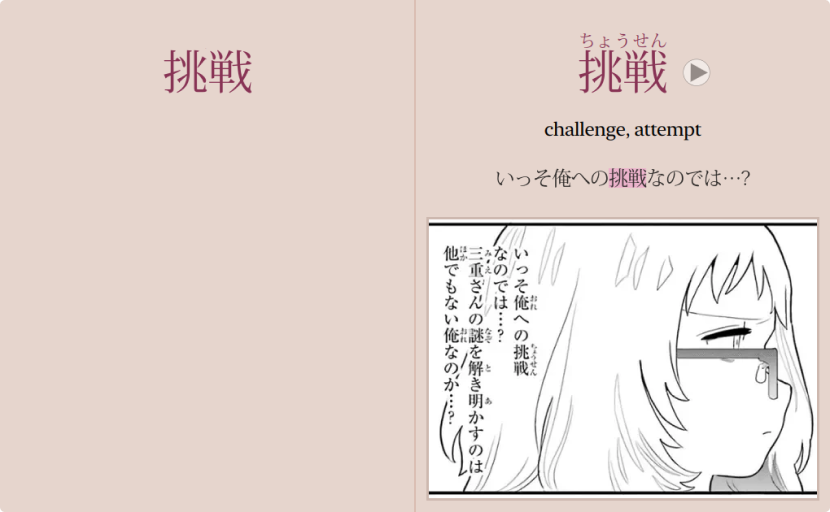
The code is available at https://gist.github.com/fauu/1e33d132b3644d04e4219135774ad2bc.
-
For manga, VNs, and games, I always mine through Kamite and then execute my post-mine screenshot script from it (
anki-screenshot.sh) in such a way that the Sentence field gets filled with text from Kamite. -
I don’t bother with recording sentence audio from VNs.
-
I highlight the target words in the sentences manually during reviews, along with fixing the sentence formatting: both done swiftly using Edit Field During Review Cloze (see Anki addons).
-
For kana-only spellings, after the first failed review, I manually fill the Hint field with the shortest self-standing phrase from the Sentence field, containing the target word. In cases where a short enough extract can’t be made, I google for a shorter example specifically for the Hint field.
-
The Sentence-English field is a leftover from the Core deck. I never fill it when mining new cards and I hid it from the card template at some point early on.
The Glossary field is pre-filled by Yomichan with a list of dictionary
definitions, but I always edit it immediately after mining, using my
anki-latest-edit-field.sh script (can be combined to run
in succession with other post-mine scripts, for example a screenshot script).
I aim to capture in that field the most representative/common meanings of the word in a very approximate way, in the form of a few keywords in a language I already understand.
In the first phase of learning a word, the keywords serve as an “anchor” around which the proper understanding of the meaning of the word will be built as I encounter it in the wild in different contexts.
As that understanding is built, the keywords gradually become simply “bridges” that lead to the actual network of associations representing the word in the mind. Ultimately, they effectively fade away almost like mnemonics (more accurately, they melt into the broad network of associations).
The most important point of this is that the keywords aren’t supposed to be some perfect and all-encompassing reflections of the meaning (most of all because they can’t be) and should be treated more as half definitions, half mnemonics. Which isn’t to say that I don’t correct and tune them during reading and Anki reviewing as my understanding of the word improves.
(The notation doesn’t make much of a difference and I don’t stick to it religiously.)
Separates keywords for meanings that can’t quite be grouped as one meaning.
歪 distorted / oval (the two senses are conceptually
related, but not in an immediately obvious enough way for me to collapse them
into a single meaning)
Used when a meaning treated as one is best approximated as an intersection of
more than one keyword.
搾取 exploitation, milking (not strictly a single
meaning, but for me conceptually close enough to collapse into one)
Used when a single keyword is a good enough approximation in terms of a
particular one of its meanings but not necessarily in terms of others.
衝動 impulse (urge)
番組 program [TV, …]
For keywords formatted in a special way (e.g. to indicate a suffix), or more
describing the concept than directly standing in for it, or ones that are
still straightforward but also more mnemonic-like than the usual keywords.
めく [-show-signs-of]
粒 grain, [small round object]
よりによって of all [things, people, days, …] /lamenting/
How strictly those rules are applied will depend on my card backlog size and on whether the given word fulfils some of the “Prefers”.
-
Avoid too obvious / too redundant cards.
If I have 歴史 and I know the suffix 的, I don’t need a card for 歴史的. Also applies to many obvious compound verbs.
-
Avoid words that are too rare (relatively to my current level).
I use Yomichan frequency dictionaries to ascertain this, combined with the feel I’ve developed over time by checking word frequencies a lot. For a rough example, at around 3.5k mature (+ suspended easy) cards in Anki, I would rarely mine anything over 10k in jpdb frequency, and practically never anything above 15k.
-
Avoid words that look easily confusable with some of my recent problematic/leech cards.
-
Avoid words for which I’m not sure I’ve even correctly grasped their rough meaning.
Instead of getting derailed into drilling deeply into definitions and example sentences, I just move on and wait for the word to re-appear organically.
-
Prefer words in the same domain as the texts I tend to consume.
-
Prefer words that I recognize but can’t remember the meaning of.
-
Prefer words where an unknown kanji is paired with a known kanji in a way that makes it easy to learn a common meaning of the new kanji through association.
-
Prefer mining words from memorable scenes in fiction.
With my focus on reading speed, the need is to prioritize learning things that will contribute more to improving reading speed in shorter term. And by that criterion, learning to recognize a very common spelling is preferred to learning a relatively uncommon one. On the other hand, the gain can’t be that great, so putting too much effort into optimizing this is also a waste.
My original rule of thumb was: look up the word on jpdb, if a kanji spelling is either the most common form or if its share is at least 30%, mine the kanji spelling. Otherwise mine the kana spelling.
This is obviously a very rough rule: for very common words, for example, it might be useful to mine the kanji form at much lower shares. Clicking on the kanji form on jpdb and seeing its own frequency (or just using the Yomichan frequency dictionary) can be helpful here: 流石 is only at 12% of usages with さすが being at 87%, but the former is still top 8600 frequency because the word is just that common.
There were instances where, as I progressed, I went back to change the kana spelling to a kanji spelling and reset the card. But the reverse also happened: if I remember correctly, うるさい, a top 1100 word, in the Core deck appears as 煩い, which is top 20700: there’s really no need to learn to recognize this spelling so early on, if instead you could learn to recognize an actual top 2k word.
-
Hard:
-
Had a 100% confirmed brainfart. (If I have doubts, I might bury the card instead or even set its due date to a week later).
-
Failed to get the meaning right but in a way that makes me believe I most likely would’ve got it right enough in context.
-
Know the only reason I got the answer right is because I had looked up the word in the recent days.
-
Got 1 sound wrong when testing for the reading.
-
Have 2+ distinct enough meanings listed but only got the 2nd, 3rd etc. one right.
-
Guessed a passive instead of an active verb variant, or vice versa, and similar mistakes.
-
-
Good—Got the answer pretty much right or got the reading wrong but decided to stop testing for the reading on this card instead of failing it (for words I seem to encounter very rarely).
-
Again—None of the excuses to hit Hard apply.
-
Easy—Don’t use.
(Hour 975) Some of those settings are no longer operational since I’ve switched to the fsrs4anki scheduler.
-
Learn ahead limit:
0 minsDon’t ignore any intervals, they’re there for a reason.
-
New cards/day:
0I always add new cards manually using Custom Study after finishing reviews. That way I can regulate the workload depending on current conditions (how enthusiastic I’ve been feeling about doing reviews lately, what’s my retention been in the last few days, how much I’ve been reading etc.).
-
Learning steps:
30s 15m 20hWhen I was still doing the Core cards, I’d have an extra step or two in there, something like
30s 1m 1h 16h 48h. -
Graduating interval:
3 -
Relearning steps:
20m -
Minimum interval:
3 -
Leech action:
Tag only -
Starting ease:
1.31 -
Interval modifier:
1.60The default value for this at
1.31ease should be1.81. Every few months I tweak the value by around0.15either way depending on various circumstances, like the monthly true retention (young and mature), which I like to keep slightly above80%. A big reason I need the interval modifier lower than the default is to compensate for Straight Rewards and Consider Immersion addons raising the intervals or postponing reviews for select cards externally. -
Hard interval:
1.00I haven’t put any thought into what this should be set to.
-
New interval:
0.05I keep this low, and if I repeatedly fail a card at 2–4 week intervals, I might tag it as “for later”, suspend it, and try resetting and unsuspending it in a few months.
-
w: (derived using the official optimizer based on the last year of reviews on my vocabulary deck) -
requestRetention:0.85
-
For normalizing loudness of card audio.
-
For good review keyboard bindings.
-
For external integrations (Yomichan, KanjiFocus).
-
Consider ImmersionFor leveraging immersion data to reduce the number of Anki reviews while retaining the same learning effects. The addon (hypothetically/hopefully) achieves this by postponing reviews of cards for words seen during immersion.
This addon hasn’t been published yet and I’ve stopped using it for now.
It turned out I might have to modify the main algorithm a bit to handle some edge cases better and then do pre-eliminary testing by using the addon for a bit more. It will be published once I get around to doing that, but this might not be soon, since I don’t spend a lot of time in Anki anyway and don’t see this as a priority.
-
Edit Field During Review Cloze
For adjusting the formatting of example sentences directly during review.
-
For enjoying my progress in the form of a big kanji grid from time to time.
-
For quickly failing cards whose words I failed to remember during reading despite favourable circumstances (I understood the context, I made a proper attempt at recall etc.). I simply open Anki browser through the book icon in Yomichan and then press a keyboard shortcut to fail the card.
(Hour 900) I haven’t been using this recently.
-
For avoiding getting distracted during reviews.
Automatically play alert after:
20 seconds
Automatically show answer after:45 seconds
Automatically Rate Again after:0 seconds(disabled) -
(Hour 975) Became unnecessary after switching to fsrs4anki.
For an alternative card ease differentiation mechanism that doesn’t require using the Easy answer button. I sometimes deliberately reset the ease by answering Hard.
Begin at straight of length:
2
Base ease reward:0.08
Step ease reward:0.00
Start at ease:1.30
Stop at ease:2.50 -
For quickly tagging cards during review in order to mark a card:
-
for testing on kanji readings; or
-
with the suspension reason, once I’ve decided to suspend the card (card redundant, too easy, too hard at the moment).
-
-
True Retention by Card Maturity Simplified
For tracking retention stats to see whether I might need to add less/more new cards or modify scheduler settings such as the Interval Modifier.
-
Support extension for the fsrs4anki scheduler. Initially used to reschedule all my cards using the algorithm.
Around hour 1060, I’ve switched to doing reviews on AnkiDroid.
FSRS4Anki isn’t supported in AnkiDroid 2.16, so for now I sync to PC and have the FSRS4Anki Helper addon automatically reschedule the cards using the proper algorithm.
Gestures: Reveal—swipe down, Good—swipe right, Again—swipe left, Hard—touch right.
I flag cards red as a substitute for adding the produce-reading tag.
To make up for the lack of the Speed Focus Mode addon, I’ve added a blink effect to the card template that happens every few seconds (in a single day-to-day comparison, this made me up to 2s faster per review).
-
Isolated kanji deck
I tried a variant of the KanjiDamage at the very start for a few days, but studying it just felt pointless compared with learning actual vocabulary.
-
Dictionary of Japanese Grammar deck
The deck is great for what it is, but I just couldn’t bother with it (I was already past the basic grammar study), in line with keeping deliberate grammar study to a minimum.
-
Two decks: 1. word audio → test meaning, 2. word text → test reading & meaning
Deck 2 would be for words where kanji readings stick, deck 1 for ones where they don’t yet or for kana-only words. This looks very promising on paper, but: 1) it requires a somewhat involved and fragile setup (a custom Anki addon to simplify moving words between the decks etc.), and 2) it made Anki sessions feel noticeably more tedious for some unknown reasons that likely weren’t even related to 1).
Hours 10–30
- Went through the first 35 videos of the main Cure Dolly playlist. I didn’t “study” the videos or try to deliberately memorize any of the information. I did take notes but I never looked at them again.
Hours 50–now
-
Went through a short grammar guide, somewhat similar to the Tae Kim guide, but definitely shorter. I can no longer find it, but it wasn’t some holy grail or anything.
-
Went through N5–N3 grammar points at https://jlptgrammarlist.neocities.org/. Mined a few of them.
-
Read Jay Rubin’s Making Sense of Japanese.
-
Later would reference https://japbase.neocities.org/ from time to time during reading.
-
Ended up doing nothing else but just having the DoJG as a Yomichan dictionary.
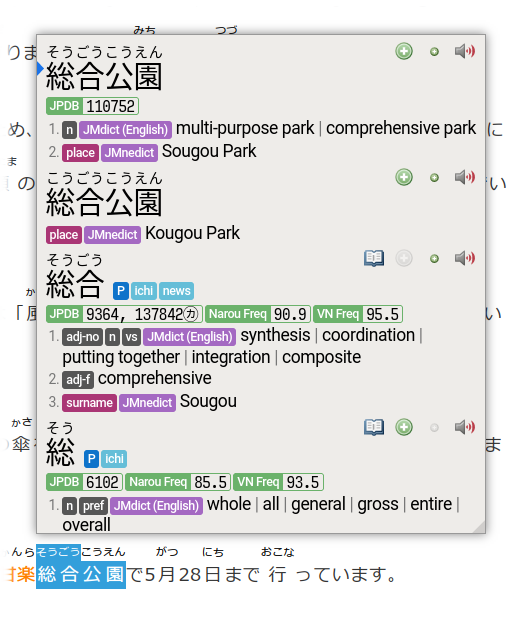
Used heavily for all reading (except on Kindle). I scan with the middle mouse button.
(Hour 900) Added a pitch accent dictionary (not pictured).
(Hour 1000) Added the CC100 frequency dictionary (not pictured).
-
KANJIDIC (kanji)
-
JMdict (general vocabulary)
-
日本語文法辞典(全集) (DoJG—grammar)
-
JMnedict (names)
-
アクセント辞典 (pitch accent)
-
JPDB (word frequencies only)
-
CC100 (“real-life” word frequencies—otaku content not over-represented)
- Everything up to here is available in shoui’s collection.
-
Narou Freq
- This and the following are available at https://anacreondjt.gitlab.io/docs/freq/.
-
VN Freq
Frequency sorting dictionary: CC100
Frequency sorting mode: Rank-based
Auto-hide search popup: 100ms
Hide popup on cursor exit: 100ms
Frequency display style: Split tags
Size: 450x500
I use custom CSS for small tweaks to make the popup more compact and its content more readable. The code is available at https://gist.github.com/fauu/d3bce15c7410dbeb19fb272f76fadf3f.
(Trigger warning: MTL advocacy)
I’m a proponent of using translations in the early phases of learning to comprehend a language, and this includes machine translations. There are a lot of people online who seem alergic to the proposition, but I’m yet to see somone express an argument that would be valid against the use of machine translations, provided that the user adheres to a few very common sense rules:
-
Don’t look at a translation until you’ve made an honest attempt at comprehending the sentence.
-
This should be obvious to anyone, seeing as it also applies to using dictionary lookups, something that’s broadly accepted and practiced.
-
What “an honest attempt” means exactly must be worked out by each person through experience.
-
-
Don’t treat the translation as God-revealed truth, but rather as a guess that has to be weighed against other information (personal guesses, dictionary definitions, the context, the intuition as to the kinds of mistakes machine translators tend to make etc.).
-
After you’ve seen the translation, go back to the sentence and make another honest attempt at comprehending it.
- This is the main point of using translations. Even mostly incorrect ones often end up providing some important clue that makes the difference between not understanding the sentence at all and being able to methodically crack it open entirely with the help of a dictionary. Or, to put it in different terms, using translations in this way can help turn incomprehensible input into comprehensible input, the latter being the kind of input that’s useful for language acquisition.
I’ve followed this method while learning to read several languages and I stand by its effectiveness. This is why I ensured Kamite removes as much friction from the process as it is reasonable to remove (it doesn’t go as far as to translate automatically, since I believe this might encourage breaking rule 1.; I also don’t like bombing third-party services with unnecessary requests). Sometimes I even use the built-in Kindle Bing translator (however clunky and subpar it might be), when I have no better option.
As your comprehension improves, the need to fall back on translations necessarily decreases and ultimately disappears entirely as there are fewer and fewer sentences that you can’t crack reasonably quickly relying only on the context and the dictionary.
In extraordinary circumstances, translations can also be used to skip over very boring (especially at a low reading speed) and seemingly inconsequential portions of the immersion content without sacrificing all the context information relating to the plot—information that might after all appear there. In that case, you ignore rules 1. and 3., and just read the translations. I’ve only ever done this once or twice, while reading my very first VN.
This document includes some approximate reading speed figures for reference.
My way of reading is pretty much always the same and it leans towards intensive reading: I aim to understand almost everything, even if at times I’m fine with being only 50% sure that I’m getting some detail right. Other times, I might even skip things when I’m almost certain they’re nothing important and I’m not in the mood for indulging them (descriptions of dishes have been the biggest offender so far). Beyond that, I try to look up every word I don’t know. My base reading tempo is slightly relaxed.
The reading speed figures are calculated based on the character counting method
used by Kamite, which counts only characters belonging to the Unicode
categories Letter, Number, and Symbol (so without separators and
punctuation marks).
Hours 10–280
I would have mpv auto-pause at the end of each subtitle, try reading it with the help of Yomichan, often follow that with referencing an English translation, and then usually have another go at the line.
-
Used Kamite extensively for this. I built it specifically to make this process smooth.
-
Started very early on, but initially did very low amounts, like 10 minutes of real time a day.
-
The anime used were around 2–4/10 difficulty in jpdb scale.
-
Ended up doing around 30 hours of anime running time total, which took, very roughly, ~110 hours of real time.
- Near the end, I was able to go through some episodes of a 3/10 jpdb scale anime in around an hour.
Graduated from this activity once I was able to read a VN without getting tired out after 20 minutes.
Hours 10–now
I OCR and Yomichan, sometimes DeepL, almost everything I don’t understand.
-
I use Kamite extensively here as well—to make the process as smooth as possible and minimize the amount of effort spent on operating OCR and so on.
-
I read either using Gomics-v or my usual web browser with the Kamite One-Click OCR userscript.
-
Within the first 600 total hours of learning time I completed around 30 volumes.
- The difficulty of the manga spanned between around L20–L30 in Natively scale.
Hours 100–now
-
Using Kamite and Textractor.
-
Had my very first attempts at reading a VN very early on (~800 cards into Core 2.3k) but initially I did very low amounts with multiday gaps, so the proper start of the activity migth’ve been more around the 1200 cards point.
-
Initially, I (almost) completed a medium/short-length VN at 2/10 difficulty in jpdb scale.
-
By the time of reaching around 600 total hours of learning time, I’ve read around 1/3 each of two further long/medium-length VNs at ~4–5/10 difficulty in jpdb scale.
- My reading speed for those VNs at that point was at 4.5k–7k characters per hour (as counted by Kamite).
-
(Hour 800) My average reading speed for Summer Pockets was above 8k characters per hour.
-
(Hour 1000) Around 11k characters per hour.
- According to speculative calculations I made at that point, had I focused solely on efficient reading as much as I could (all listening and manga reading replaced with VN/LN/WN reading) and optimized around the edges (no funny secondary Anki decks etc.), I could’ve arrived at this reading skill level in around 825 hours instead of 1000. Further—and this is even more speculative—if the “strike while the iron is hot” effect is as advantageous as speculated, and if I had taken advantage of it by condensing my study time to 4 hours per day on average, it perhaps could’ve been not 825 hours but 725 (or even less—hard to even speculate this deep, but the starting point of the estimation—the 1000 hours—could already be over-estimated by 100 hours). At 4 hours per day, 725 total hours means just 6 months of study from scratch in order to be able to read some cool works at a relatively decent speed (at most 1.8x slower than the voice acting speed?). (This is just informed speculation that people who are in a hurry and are very motivated should find encouraging. Personally, I wouldn’t have changed anything.)
-
(Hour 1050) Had two >1h reading sessions at 13k characters per hour (different routes).
-
Hours 350–now
- By 600 hours of total learning time, I’ve played a bit of two Textractor-hookable dialogue-heavy games for the sake of variety and checking out how the process works out.
Hours 100–now
-
Quite early on, I went through a few chapters of a ~5/10 jpdb scale, L30 Natively scale light novel I had read in English a year or two earlier.
-
Before reaching around 600 total hours of learning time, I’ve also read 20 chapters of a new web novel with difficulty ratings same as above.
-
On top of using Yomichan directly on syosetu.com, I would use Kamite with automatic clipboard send + a lookup script to quickly translate problematic sentences in DeepL.
-
At that time, I already did some of the reading on a Kindle with JMDict instead, but back then, the slower and less accurate lookups wasted too much time, in my estimation, relatively to reading on PC.
-
-
(Hour 700) Began to read on Kindle more.
-
(Hour 800) My average reading speed for light novels (on the medium-easy side?) was approaching 6k characters per hour (below that on Kindle, above that on PC).
-
(Hour 900) Started reading web novels on an Android phone sometimes using Kiwi Browser and Yomichan (basically equivalent speed to PC).
-
(Hour 975) Had my first few WN reading sessions with a pace above 10k characters per hour on PC/Android.
-
(Hour 1100) Average WN reading paces (PC/Android):
-
10750 CPH for ”mundane” real-world works (had sessions suprassing 12k),
-
8250 CPH for fantasy-themed works with lore dumps and combat sequences.
-
Hours 280–now
This became my default mode for watching anime after I had progressed past reading Japanese subtitles with constant pausing. The process (using mpv):
-
English (or French/Italian for double gains) translated subtitle appears.
-
Playback is immediately automatically paused (sub-pause-advanced script).
- Steps 2. and 4. are automatically skipped for sufficiently short subtitles by the script.
-
I quickly get the gist of the subtitle.
-
Playback is automatically resumed after an interval indirectly corresponding to the subtitle length. The subtitle is hidden.
-
I listen to the line being spoken with full attention and with the intention to comprehend it.
This is obviously not the perfect viewing experience, but for me it’s still decidedly more enjoyable than any of the following alternatives:
-
Watching with translated subtitles but no pauses, resulting in mostly not being able to pay full attention to the audio.
-
Watching without translated subtitles and without pausing, resulting in not understanding the major portion of the content (personally the least enjoyable option of all—I’ve tried it for around 20 episodes).
-
Watching without translated subtitles but with enough pauses to understand most of the content. (Obviously only up to a point: this should become more enjoyable than translation-assisted listening once the number of necessary pauses decreases sufficiently).
-
Not watching at all.
Hours 800–now
I slowly began introducing listening to various raw audio recordings here and there.
Hours 780–now
I returned (see 4.1. Reading anime subtitles) to JP-subtitled anime once I reached the point where I could comprehend simple ones (e.g. Kubo-san, K-On!!—so around 2–3/10 jpdb scale) mostly in real time, only occasionally pausing to catch up or to look something up (still through Kamite).
-
Watching anime scene-by-scene by first watching a scene raw with low comprehension and then going through the subtitles slowly to understand everything.
This was more enjoyable than just raw listening, but ultimately it made me occupied too much with finding good stopping points and operating the player’s mark-seek mechanism, leaving less attention for just absorbing the language.
Hours 1030–now
Eventually it’d be nice to at least be able to write down words using kana. I’ve started to practice handwriting with the Kanji Dojo Android app, very occasionaly.
-
Did some Duolingo over time for fun (~3 hours total at 600 hours of learning).
-
Listened to a lot of Japanese songs while playing osu!. This isn’t counted in the total learning time, because I generally don’t pay attention to the lyrics, making this effectively “white-noising” and presumably of practically no worth for learning.